
Ten years ago, at the birth of hypersports bikes in
the middle '80s, Yamaha contributed to the new wave with the FZR1000 --
and for five years they ruled the roost of ultimate sports machinery.
In 1992, Honda's legendary Fireblade stole the show on sales floors
around the world, and now Yamaha is vying to win back their claim to
produce the fastest, quickest, best-handling -- and best-selling --
motorcycle coming out of Japan. With Suzuki bringing the the ultra-light
1996 GSXR750 to the field, it's a three-way battle for the title.
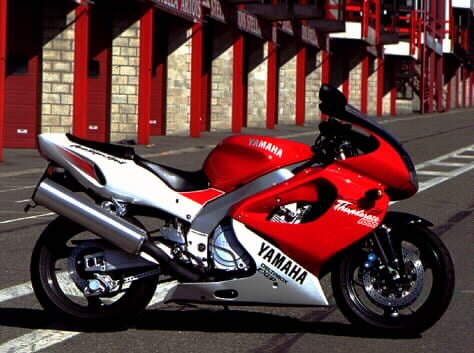
Sportbike enthusiasts have never had it so good. The Thunderace is
actually a bit of a mongrel, the 5-valve four-cylinder mill was spawned
from an FZR1000 mold, and the frame was adapted from the vastly
underrated YZF750R. The Genesis engine has undergone some changes aimed
at improving mid-range power rather than the maximum output, which
remains 145 bhp. The rotating mass of crankshaft and pistons have been
lightened to improve throttle response, and new carburetors equipped
with "Throttle Position Sensors" give the ignition some more data to
help control the EXUP valve in the exhaust pipe. The engine spins freely
and quickly, producing usable power from as low as 2000 rpm. At 3500
rpm it gets serious, and by 5000 the big Yamaha launches you into orbit,
pulling cleanly with seamless, linear power all the way up to its
11,500 rpm redline.
Carburetion is good, with no flat spots or hesitation as the bike
launches down the road to show 70 mph in first gear and 100 mph in
second. All this power is delivered through a five speed gearbox that
was still a bit tight but performed faultlessly throughout the test.
Keep on redlining it in each of the gears and you'll find yourself
heading for what feels like a world landspeed record with an indicated
170 mph showing on the dials flat out in top gear. Yamaha claims the
fairing fitted to the Ace is the slipperiest ever worn by any of their
street bikes, with a drag coefficient of only 0.29 -- very close to
their YZR500 GP bike -- but it seems to do little to improve top speed,
or fuel consumption for that matter. At the speeds the YZF is capable of
the bike develops a thirst that will have you calling in at most of the
gas stations along the journey; while managing a sensible 33 mpg at
regular speeds, this drops to less than 23 mpg at speeds above 120 mph.
Riding two-up, you might not even reach the next gas station.

The
best strategy for avoiding frequent gas stops is to take to the
backroads, since, capable though it is at long distances on the freeway,
it is even better in squid territory. One of the objectives of the
design team was to come in lighter than the FZR1000, and at 198 kilos
(435 pounds), the Ace weighs in as the leanest litre class bike. This,
coupled to the shorter wheelbase chassis (only 10mm more than the
YZF750), has done wonders for the handling of the bike, which now cuts
through the corners as quickly as one of the sports 600s. But it takes a
little getting used to, as you are initially aware of the mass of the
bike and the wide fuel tank makes it difficult to grip with your legs.
But put this out of your mind, flick the bike hard into a bend and
it will track through without dramatics. Although steering might be
judged a tad slower than the GSXR750 and the CBR900RR, it's more than
adequate, and the bike feels very stable and settled. The Dunlop D204
Sportmax IIs suit the bike well, giving good grip, sliding some under
radical conditions, but without the feeling they will let go completely.
Blitzing corners is made even more fun by the phenomenally powerful
four-piston front brake calipers on 298mm rotors that are better than
the YZF750's and Kawasaki ZX7R's binders. Leave the gas on a little too
late and you'll still be okay, although mid-corner braking will have the
bike wanting to stand up some and hustling it through the rest of the
corner is more work than usual. The twin-pot brakes on the rear were
great, providing heaps of feel and not cramping a foot throughout either
of our tests.

It seems that the fashion for upside-down front forks is waning; the
YZF comes equipped with conventional telescopic front forks. At 48 mm
in diameter, they are plenty stiff for any street-legal tire. Full
adjustment of bump and rebound damping, as well as the usual spring
preload adjustment, is possible on both forks and rear shock. The
suspension comes set up a little on the hard side, but can be softened
out for relaxed rides over uneven surfaces. In fact the complete bike is
remarkably relaxed for a 145 bhp sport machine, making lane splitting
through the morning gridlock and the slow trickle through suburbia less
of a pain than could be expected. Throttle and clutch are light, the
brakes one-finger sensitive and the steering light even at low speeds.

One thing that did bother us was the vibrating mirrors; an important
consideration on a bike like this if you intend to keep your licence.
Steps have been taken to minimize the discomfort vibration may cause the
rider, with large weights on the ends of the bars and rubber grips on
the footrests. These work well, with the rider aware of the vibration,
but not uncomfortably so. The seating position and relationship to the
bars and pegs is quite comfortable, striking a good balance between the
bike's intended roles of sports riding and touring.

 Ten years ago, at the birth of hypersports bikes in
the middle '80s, Yamaha contributed to the new wave with the FZR1000 --
and for five years they ruled the roost of ultimate sports machinery.
In 1992, Honda's legendary Fireblade stole the show on sales floors
around the world, and now Yamaha is vying to win back their claim to
produce the fastest, quickest, best-handling -- and best-selling --
motorcycle coming out of Japan. With Suzuki bringing the the ultra-light
1996 GSXR750 to the field, it's a three-way battle for the title.
Sportbike enthusiasts have never had it so good. The Thunderace is
actually a bit of a mongrel, the 5-valve four-cylinder mill was spawned
from an FZR1000 mold, and the frame was adapted from the vastly
underrated YZF750R. The Genesis engine has undergone some changes aimed
at improving mid-range power rather than the maximum output, which
remains 145 bhp. The rotating mass of crankshaft and pistons have been
lightened to improve throttle response, and new carburetors equipped
with "Throttle Position Sensors" give the ignition some more data to
help control the EXUP valve in the exhaust pipe. The engine spins freely
and quickly, producing usable power from as low as 2000 rpm. At 3500
rpm it gets serious, and by 5000 the big Yamaha launches you into orbit,
pulling cleanly with seamless, linear power all the way up to its
11,500 rpm redline.
Ten years ago, at the birth of hypersports bikes in
the middle '80s, Yamaha contributed to the new wave with the FZR1000 --
and for five years they ruled the roost of ultimate sports machinery.
In 1992, Honda's legendary Fireblade stole the show on sales floors
around the world, and now Yamaha is vying to win back their claim to
produce the fastest, quickest, best-handling -- and best-selling --
motorcycle coming out of Japan. With Suzuki bringing the the ultra-light
1996 GSXR750 to the field, it's a three-way battle for the title.
Sportbike enthusiasts have never had it so good. The Thunderace is
actually a bit of a mongrel, the 5-valve four-cylinder mill was spawned
from an FZR1000 mold, and the frame was adapted from the vastly
underrated YZF750R. The Genesis engine has undergone some changes aimed
at improving mid-range power rather than the maximum output, which
remains 145 bhp. The rotating mass of crankshaft and pistons have been
lightened to improve throttle response, and new carburetors equipped
with "Throttle Position Sensors" give the ignition some more data to
help control the EXUP valve in the exhaust pipe. The engine spins freely
and quickly, producing usable power from as low as 2000 rpm. At 3500
rpm it gets serious, and by 5000 the big Yamaha launches you into orbit,
pulling cleanly with seamless, linear power all the way up to its
11,500 rpm redline.  It seems that the fashion for upside-down front forks is waning; the
YZF comes equipped with conventional telescopic front forks. At 48 mm
in diameter, they are plenty stiff for any street-legal tire. Full
adjustment of bump and rebound damping, as well as the usual spring
preload adjustment, is possible on both forks and rear shock. The
suspension comes set up a little on the hard side, but can be softened
out for relaxed rides over uneven surfaces. In fact the complete bike is
remarkably relaxed for a 145 bhp sport machine, making lane splitting
through the morning gridlock and the slow trickle through suburbia less
of a pain than could be expected. Throttle and clutch are light, the
brakes one-finger sensitive and the steering light even at low speeds.
It seems that the fashion for upside-down front forks is waning; the
YZF comes equipped with conventional telescopic front forks. At 48 mm
in diameter, they are plenty stiff for any street-legal tire. Full
adjustment of bump and rebound damping, as well as the usual spring
preload adjustment, is possible on both forks and rear shock. The
suspension comes set up a little on the hard side, but can be softened
out for relaxed rides over uneven surfaces. In fact the complete bike is
remarkably relaxed for a 145 bhp sport machine, making lane splitting
through the morning gridlock and the slow trickle through suburbia less
of a pain than could be expected. Throttle and clutch are light, the
brakes one-finger sensitive and the steering light even at low speeds.  One thing that did bother us was the vibrating mirrors; an important
consideration on a bike like this if you intend to keep your licence.
Steps have been taken to minimize the discomfort vibration may cause the
rider, with large weights on the ends of the bars and rubber grips on
the footrests. These work well, with the rider aware of the vibration,
but not uncomfortably so. The seating position and relationship to the
bars and pegs is quite comfortable, striking a good balance between the
bike's intended roles of sports riding and touring.
One thing that did bother us was the vibrating mirrors; an important
consideration on a bike like this if you intend to keep your licence.
Steps have been taken to minimize the discomfort vibration may cause the
rider, with large weights on the ends of the bars and rubber grips on
the footrests. These work well, with the rider aware of the vibration,
but not uncomfortably so. The seating position and relationship to the
bars and pegs is quite comfortable, striking a good balance between the
bike's intended roles of sports riding and touring.


0 comments :
Post a Comment