
 When was the last time you heard of a waiting list for a Japanese
motorcycle? For 1999 the power-to-weight wars will most likely turn into
top-speed skirmishes. Suzuki is rumored to be introducing a big-bore
replacement for the GSX-R1100 with projected top speeds of over 200 mph
and claimed horsepower output close to 170 bhp. Even once-beens are
jumping into the fray.
When was the last time you heard of a waiting list for a Japanese
motorcycle? For 1999 the power-to-weight wars will most likely turn into
top-speed skirmishes. Suzuki is rumored to be introducing a big-bore
replacement for the GSX-R1100 with projected top speeds of over 200 mph
and claimed horsepower output close to 170 bhp. Even once-beens are
jumping into the fray.Shhh! We heard something else: Muted laughter and something that sounds like a cash register. Oh yeah, that's coming from the actuaries and underwriters at America's insurance companies. Cha-ching.

Amidst all this single-minded testosterone production, Honda has gone back to the future in order to fight the future.
While other manufacturers concentrate on two-wheeled adrenaline fixes and penile enhancements, Honda reached back into their own, proud racing heritage to build what might be -- hell, why hedge? -- what is the most versatile, best-balanced sportbike ever made: The all-new 1998 VFR800FI Interceptor. In 1983 Honda introduced the original VF750F Interceptor.

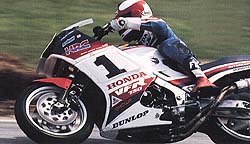 In 1990 Honda's 750cc V-4 line split as they introduced the
race-track focused RC30 and the street-oriented VFR750F simultaneously.
In 1994 the split was further magnified with the debut of the
street-legal-in-theory-only RC45 and the friendly, forgiving,
comfortable, stylish and red-red '94 VFR750F, a motorcycle that would
grab a stranglehold on the enthusiast press Best 750 Street Bike awards,
the kind of which would make Saddam Hussein jealous.
In 1990 Honda's 750cc V-4 line split as they introduced the
race-track focused RC30 and the street-oriented VFR750F simultaneously.
In 1994 the split was further magnified with the debut of the
street-legal-in-theory-only RC45 and the friendly, forgiving,
comfortable, stylish and red-red '94 VFR750F, a motorcycle that would
grab a stranglehold on the enthusiast press Best 750 Street Bike awards,
the kind of which would make Saddam Hussein jealous.Still, despite it's popularity in Europe, the U.S. sales of the 1990 and 1994 VFR incarnations were not overwhelming. Bikes in the 600cc category offered better acceleration and handling for almost $2000 less, and both the 1996 GSX-R750 and new, liter-class sportbikes offered superior power-to-weight ratios for the same price. Never intended as a pure sportbike, the VFR750F had not only lost ground to the more narrowly focused GSX-R750, but also to two of Honda's VTR1000F Super Hawk.
 Honda's own: the CBR1100XX as a fast sports-tourer and the VTR1000 as a rider-friendly street-sportbike.
 Performance is inspired by the RC45 superbike, and the chassis by the VTR1000F. Add a new fuel-injection system, improved suspension and the 800 Interceptor is faster, quicker and more responsive. Redesigned ergonomics and improved wind protection make the Interceptor even more comfortable than the already cushy VFR750.
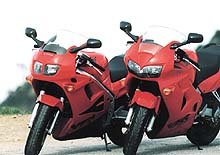
 Despite the fact that the riding position is actually a little more
upright than the 750's -- the handlebars are slightly higher -- Honda
The Interceptor (foreground) cuts a sleek profile and Honda claims that
the drag coefficient is 9 percent lower, due to venting under the
windscreen that raises the height of the air stream hitting the rider at
highway speeds. Wind and weather protection is better than the 750 and
certainly better than the half-faired VTR.
Despite the fact that the riding position is actually a little more
upright than the 750's -- the handlebars are slightly higher -- Honda
The Interceptor (foreground) cuts a sleek profile and Honda claims that
the drag coefficient is 9 percent lower, due to venting under the
windscreen that raises the height of the air stream hitting the rider at
highway speeds. Wind and weather protection is better than the 750 and
certainly better than the half-faired VTR.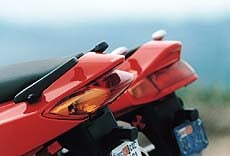 Everyone who rode the 800 remarked about how much less wind
resistance they felt at highway speeds and how much more comfortable the
riding position is -- improvements not often associated with enhancing
the sport riding aspects of a motorcycle -- yet they noticed that the
800 still feels sleeker, slimmer and sportier than its predecessor.
"Cool, check this out," said Associate Editor Billy Bartels late last
year after receiving Honda's 1998 new product press releases. "The new
VFR has this cool race-like single-piece tail end with a cool tail light
..." It's the most obvious stylistic departure from the 750 and one of
the first things noticed. Sleek and aggressive, the tail light lens is
cleanly integrated into the single-piece tail end. Not only does it look
more modern, Honda claims it provides better visibility.
Everyone who rode the 800 remarked about how much less wind
resistance they felt at highway speeds and how much more comfortable the
riding position is -- improvements not often associated with enhancing
the sport riding aspects of a motorcycle -- yet they noticed that the
800 still feels sleeker, slimmer and sportier than its predecessor.
"Cool, check this out," said Associate Editor Billy Bartels late last
year after receiving Honda's 1998 new product press releases. "The new
VFR has this cool race-like single-piece tail end with a cool tail light
..." It's the most obvious stylistic departure from the 750 and one of
the first things noticed. Sleek and aggressive, the tail light lens is
cleanly integrated into the single-piece tail end. Not only does it look
more modern, Honda claims it provides better visibility.Although the 750 got a bigger thumbs up from our pillion passenger because it was sprung softer, there were no complaints about 800's comfort or the rear-passenger riding position. The seat itself is, well, a competent stock seat, meaning it's not exactly a Corbin seat, but then neither does it suck. It's hard to get excited about it either way.
The new RC45-inspired V-4 engine shares the same basic fundamental design as the 750's, a 90-degree, liquid-cooled DOHC powerplant with a right side-mounted gear-driven cam train. Displacement has been increased to 782cc's due to a 2mm larger bore than the 750 and a 2mm longer stroke than the RC45 (750 bore x stroke -- 70.0mm x 48.6mm; RC45 -- 72mm x 46mm; 800 -- 72mm x 48mm).
 New, redesigned pistons coated with a solid lubricant and all-new,
aluminum composite cylinder sleeves combine to create a slightly higher
compression ratio (800 -- 11.6:1, 750 -- 11.0:1). The new engine is
lighter and 15mm slimmer than the 750's. For better mid-range punch the
crankshaft remains 180 degrees as compared to the RC45 superbike's
360-degree crank. As for the 750's highly regarded, smooth-shifting
tranny, the 800 is just as smooth.
New, redesigned pistons coated with a solid lubricant and all-new,
aluminum composite cylinder sleeves combine to create a slightly higher
compression ratio (800 -- 11.6:1, 750 -- 11.0:1). The new engine is
lighter and 15mm slimmer than the 750's. For better mid-range punch the
crankshaft remains 180 degrees as compared to the RC45 superbike's
360-degree crank. As for the 750's highly regarded, smooth-shifting
tranny, the 800 is just as smooth.Like the RC45, the new 800 is fuel injected, but, believe it or not, the 800 boasts the next step in its development. The 800's EFI system is smaller and more compact than the RC45's (800's fuel injectors are 65.1mm long, RC45's are 74.0mm) and at least two-pounds lighter. Each cylinder is digitally mapped to help provide precise fuel delivery and spark control.
Exhausts exit through a four-into-two-into-one exhaust system that features a huge, heavy, 6.4-liter stainless-steel can. For those interested in reducing weight, replacing the stock muffler with an aftermarket silencer can take as much as four to five pounds off.

Although the 800 feels a tad flatter than the 750 on the bottom, throttle response, particularly after 3200 rpm, is crisp and immediate. Power is delivered evenly. There is no lean surge as found on BMW's, no noticeable flat spots like those found on stock T-series Triumphs, and it lacks the mapping flaws that plague the TL1000S.
As with any fuel-injected motorcycle, smooth throttle control is important, particularly mid-corner. At the VRF800 intro, a relatively heavy-handed member of the press, to the bemusement to the Honda engineers who believed they had gotten this one right, complained that the fuel-injection was too precise, too crisp, too immediate, saying he preferred the carbureted VFR750.
 True, the fuel-injected 800 demands more vigilance and more refined
inputs than the 750. While neither motor approaches open-class power,
where you might downshift twice on the 750 to pass, you can usually get
away with only one downshift on the 800, if any at all, and with the
throttle response being what it is, you'll certainly jet off quicker
once the throttle is twisted. This is a motorcycle that can easily be
ridden in one gear.
True, the fuel-injected 800 demands more vigilance and more refined
inputs than the 750. While neither motor approaches open-class power,
where you might downshift twice on the 750 to pass, you can usually get
away with only one downshift on the 800, if any at all, and with the
throttle response being what it is, you'll certainly jet off quicker
once the throttle is twisted. This is a motorcycle that can easily be
ridden in one gear.Although the VTR is torquier and produces more top-end horsepower and the 800's horsepower and torque gains over the 750 are modest, the 800, in part because of its excellent fuel-injection system, feels fast and powerful, yet smooth. The 800 reaches peak torque quickly, though not as fast as the twin-cylindered VTR, and holds it for over 3000 rpms, from 6000 to 9000 rpm.
The 800 also reaches the upper limits of its horsepower quicker (though the 750 does reach peak horsepower at 9750 rpm compared to the 800's 10250 rpm) and holds it longer than the 750 (Dyno Charts are here). That is the advantage of progress. Basically, ham-fisted riders will have to teach their right hands better habits. Simply put, we feel that this was one of the smoothest, most refined fuel injection systems we've tested.
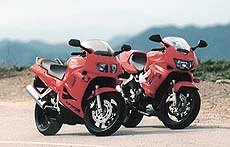 On any road under any condition the 800 will easily pull away from
the 750, and only on the very tight, twisting mountains roads of Malibu
did the VTR truly pull away from the 800. It is there (along with
wheelies) where the VTR shows it's only real advantage over the 800.
However, as a sport-touring ride, the 800 slaps the VTR around.
On any road under any condition the 800 will easily pull away from
the 750, and only on the very tight, twisting mountains roads of Malibu
did the VTR truly pull away from the 800. It is there (along with
wheelies) where the VTR shows it's only real advantage over the 800.
However, as a sport-touring ride, the 800 slaps the VTR around.The Super Hawk has a horrendous cruising range, about 120 miles from a five gallon fuel capacity (4.2 gallon tank with a .9 gallon reserve) while the 800 posted 200-mile intervals between fill-ups. The 800 is also a more confidence-inspiring ride, meaning that it's easier to ride on unfamiliar roads and corners. Of course, the fact that it is more comfortable over longer distances and offers far superior wind and weather protection goes without saying.
Similar to the VTR1000F, the 800 Interceptor features side-mounted twin radiators. Honda claims that cooling efficiency is improved by taking advantage of the difference in air pressure between the higher-pressure air cavity and the lower pressure outer fairing surface, drawing air through the radiator at highway speeds. The side-mounted radiators also allowed the wheelbase to be reduced 1.2 inches and the engine to be mounted closer to the front wheel for improved weight bias and a lower center of gravity. The result is a better handling and lighter, neutral turning motorcycle.


0 comments :
Post a Comment