

Nevertheless, my biggest surprise at the launch of the 2012 S1000RR was the boundless enthusiasm each engineer, no matter if gray hair or no hair, showed in regard to sportbikes. There’s a lot more to this performance-driven crew than just building transportation appliances, as we found out at the Ricardo Tormo circuit in Valencia, Spain, where the bike’s 2012 edition was sampled by the world’s media last week.

These sportbike enthusiasts are responsible for the overhaul of our 2010 Motorcycle of the Year just two years after first blowing our minds at its first press launch. No other literbike has such an accelerated pace of development.
Sure, this latest version has only seemingly modest refinements, but, as the aforementioned Poschner told us, “It’s definitely more than just a facelift.”
The Walk-around
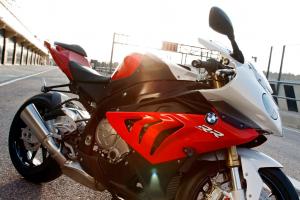 Outwardly, our test bikes were outfitted with a new Racing Red and
Alpine White color combo that looks fresh. Also in attendance were a few
RR’s in a new Bluefire color that just needs some Rizla decals to mimic
the Suzuki MotoGP bikes. Returning for another go-‘round is the classy
four-color BMW Motorsports scheme, as well as a Sapphire black metallic
version that substitutes a black-anodized swingarm in place of the raw
aluminum finish on the others.
Outwardly, our test bikes were outfitted with a new Racing Red and
Alpine White color combo that looks fresh. Also in attendance were a few
RR’s in a new Bluefire color that just needs some Rizla decals to mimic
the Suzuki MotoGP bikes. Returning for another go-‘round is the classy
four-color BMW Motorsports scheme, as well as a Sapphire black metallic
version that substitutes a black-anodized swingarm in place of the raw
aluminum finish on the others. More Than Skin Deep
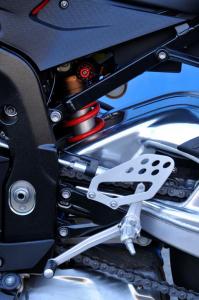
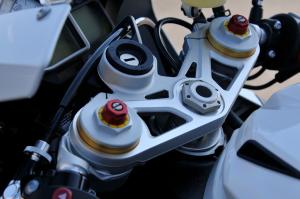 The frame change plus a shorter rear shock, less fork offset and fork
tubes held 5mm higher in the triple clamps result in a rake angle
0.1-degree lazier at 24.0 degree and 2.5mm of additional trail to
98.5mm. These minute changes can result in marginally heavier steering,
but this is balanced by a 10mm wheelbase reduction to 56.0 inches and a
slightly higher center of gravity. A slipperier steering head bearing
also reduces effort at the bars.
The frame change plus a shorter rear shock, less fork offset and fork
tubes held 5mm higher in the triple clamps result in a rake angle
0.1-degree lazier at 24.0 degree and 2.5mm of additional trail to
98.5mm. These minute changes can result in marginally heavier steering,
but this is balanced by a 10mm wheelbase reduction to 56.0 inches and a
slightly higher center of gravity. A slipperier steering head bearing
also reduces effort at the bars. Suspenders Animation
The fork now features a mid-speed damping valve that builds up compression damping with greater precision, and the damping adjusters now operate in a more linear fashion – previously, there was a wide variance in positions 1 to 5, with smaller increments between 6 and 10.
Meanwhile, the diameter of the shock’s piston rod has been increased to allow more oil to flow through the low/mid-speed valve, and, combined with revised needle geometry, results in a linear buildup of damping force. A new check valve completely separates the influence of rebound damping on the compression damping.
Let’s Ride!
 As it was my first time at the Valencia GP circuit, I agreed to the
recommendation of starting off in the RR’s Rain mode instead of the more
powerful Sport, Race or Slick selections. New for 2012, the Rain
setting now boosts maximum power to 163 crankshaft ponies, a bump of 11
horses, which felt plenty adequate while navigating a new track.
However, the Rain mode also has a more intrusive traction-control
calibration and restricts power while leaned over past 38 degrees, so on
the third lap I switched to Sport.
As it was my first time at the Valencia GP circuit, I agreed to the
recommendation of starting off in the RR’s Rain mode instead of the more
powerful Sport, Race or Slick selections. New for 2012, the Rain
setting now boosts maximum power to 163 crankshaft ponies, a bump of 11
horses, which felt plenty adequate while navigating a new track.
However, the Rain mode also has a more intrusive traction-control
calibration and restricts power while leaned over past 38 degrees, so on
the third lap I switched to Sport. Now with its massive 180-rear-wheel-horsepower on tap, the S1000 rocketed down Valencia’s front straight. A shorter-turn throttle and lighter throttle spring gives quicker access to full power, augmented by using the same throttle curve as Race and Slick modes (previously four separate curves). The 20% larger air intakes, repositioned exhaust catalyzers and revised ECU tuning are said to improve power production between 5000 and 7500 rpm, but all I could discern is this is still the fastest literbike in any straight line!
 BMW’s S1000RR is still the quickest literbike down a straightaway. BMW’s S1000RR is still the quickest literbike down a straightaway. |
Trackday junkies will still find the electronic settings in Sport mode not liberal enough. Throttle application is restricted when leaned over past 45 degrees, which is still well within the adhesion levels of the Metzeler K3 Racetecs. Sport mode also limits wheelies, which, on a sportbike this powerful, is a regular occurrence. However, the wheelie-control system is now less herky-jerky. It has the same thresholds for the four modes, but revised calibration results in a slower reapplication of power after ECU brings down the front wheel.
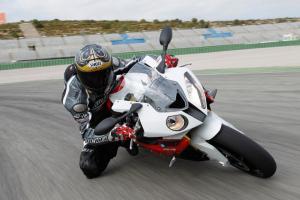
When I wasn’t thinking about electronics, I was enjoying what seemed to be marginally quicker steering response. Although still not with the class-leading agility of a CBR1000RR, BMW’s RR is easily coaxed into a lean and feels composed in corners.
 Getting down on one knee to prey. Getting down on one knee to prey. |
Race Face
Next up was the Race setting which has higher limits than most non-racers – a rider will need more than 48 degrees of lean before throttle application is affected, which is a steeper angle than most riders comfortably achieve. This higher-performance setting also allows higher wheelies before power is reduced to bring them down.
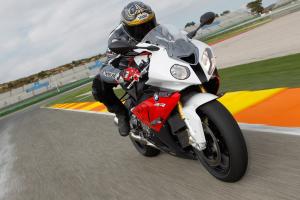 The S1000 nudges 160 mph on the front straight before a rider needs
to bleed off speed for Turn 1. Pushing my braking point a bit later, I
hammered the powerful Brembos and was met with some ABS intervention
through the front lever as the rear wheel was lifting off the ground,
which is as the Race ABS intends in Race mode. Its unexpectedness caused
a bit of a fright, but it’s a condition that can be averted by
switching to the ultra-performance Slick mode or disabling the ABS.
The S1000 nudges 160 mph on the front straight before a rider needs
to bleed off speed for Turn 1. Pushing my braking point a bit later, I
hammered the powerful Brembos and was met with some ABS intervention
through the front lever as the rear wheel was lifting off the ground,
which is as the Race ABS intends in Race mode. Its unexpectedness caused
a bit of a fright, but it’s a condition that can be averted by
switching to the ultra-performance Slick mode or disabling the ABS.| A Weighty Solution |
| Little known fact: In 2009, during its inaugural season in World Superbike competition, BMW was having difficulties getting the S1000RR to hook up when driving out of corners. So, seven months after beginning series production of the S1000, BMW added approximately a pound of weight to its crankshaft with the intent of enhancing driveability of the WSB weapon. BMW engineers tell us not much difference could be felt on the streetbike, but it did aid the racebike, which has to use a stock crankshaft. |
Slick Is Quick
Slick mode allows fast riders to push the machine’s limits, allowing up to a dizzying 53 degrees of lean angle before throttle application intervention, and the traction-control setting permits a fair amount of rear-tire drift to help steer the bike during corner exits. And intervention from the TC is smooth despite considerable rear slip. The DTC is reassuring and really aids confidence on corner exits. If you’re especially brave, DTC can be disabled with a long push of a single button. It’s worth noting here that not one of the S1000RRs hit the deck due to a loss in traction.
 After getting accustomed to riding near the speed of light, I finally
had a chance to notice the revised instrumentation. The prominently
placed analog tach has larger numbers on its white face for easier
reading, augmented by the returning white shift light. The LCD info
screen can now be set of one of five brightness displays. Also new is a
“best lap in progress” indicator that responds every 100 meters to tell a
rider if he’s on a pace quicker than the previous quickest lap.
After getting accustomed to riding near the speed of light, I finally
had a chance to notice the revised instrumentation. The prominently
placed analog tach has larger numbers on its white face for easier
reading, augmented by the returning white shift light. The LCD info
screen can now be set of one of five brightness displays. Also new is a
“best lap in progress” indicator that responds every 100 meters to tell a
rider if he’s on a pace quicker than the previous quickest lap.In the corners, it’s difficult to say for certain if the new RR has the improved steering accuracy and feedback promised via its chassis changes, but I honestly had zero quibbles about its responsiveness and precision. It obediently goes where it’s pointed, and it feels stable and communicative when carving around an apex. Also commendable was the non-existence of major setup issues, as all the riders I polled weren’t bothering to mess with significant suspension adjustments.
 Picking a precise line is easy on the S1000RR. Picking a precise line is easy on the S1000RR. |
The Verdict
Well, since BMW’s uber-bike was already a standout in its class, it shouldn’t be a surprise to find out this slightly improved model gets a very high rating. The class-dominating S1000RR is now even more potent and usable for 2012. And after getting to know the engineering and testing brain trust behind the RR, I’m fully confident they’ll never take a backward step.
Pricing has yet to be determined, but with the aggressive MSRP of the previous version ($13,950 base) and continual elevation of prices among the Japanese competition, the S1000RR might be a relative bargain. After all, how many thousands would you have to spend to get another 30 hp from a Yamaha R1…?
 Our experience on the 2012 BMW S1000RR tells us that the uphill literbike struggle for its rivals just got a little steeper. Our experience on the 2012 BMW S1000RR tells us that the uphill literbike struggle for its rivals just got a little steeper. |


0 comments :
Post a Comment