With so much hype surrounding Ducati’s 1199
Panigale – the successor to the 1198 superbike – we found it worthy to
conjure up what we think the bike will be like in our 2012 Ducati 1199 Panigale Preview.
We based much of that article around various sources, some of which are
more reliable than others. And while much of what’s written about the
1199 and its architecture are simply educated speculations, yesterday Ducati
released official information about the new game-changing powerplant,
dubbed the “Superquadro” in anticipation of the model’s unveiling at
EICMA next month.
It’s interesting to note that design sketches for the new machine
began in 2008, the same year the much-heralded 1098R, which is
essentially the same motorcycle Carlos Checa rode to this year’s World
Superbike title, was released. It would seem logical then that the 1199
was at least a napkin sketch at the time of the 1098R’s unveiling.
Having been at the world introduction of the 1098R, I can personally
account for the buzz regarding it and its racing potential. To think
that Ducati wasted no time drawing up its successor is a glimpse into
the life cycles of design and how far forward manufacturers are
thinking.

We stated in the preview story that the name
stems from the engine’s highly oversquare bore and stroke dimensions. We
guessed bore dimension correctly at 112mm, but were off just a tenth of
a millimeter high in stroke dimension. In actuality it will be set at
60.8mm, for a bore/stroke ratio of 1.84:1. Such a short stroke length is
needed in order for the engine to safely spin fast enough to produce
the amount of power Ducati engineers felt would make it competitive
against four-cylinder machines – a walloping 195 horses and 98 ft.-lbs
(at the crankshaft), rates the factory.
Up Top
We were slightly off in regards to the engine’s redline, as we
predicted the Superquadro would spin to at least 12,000 rpm. In reality
the rev limiter is set to kick in at 11,500 rpm. Still, that’s a big
number for a Twin. Speaking of big numbers, if Ducati’s claim of 195
crankshaft horsepower is correct, that would make the 1199 Panigale the
most powerful production V-Twin ever, even putting it directly on par
with its Japanese – and German – four-cylinder counterparts.
It’s
worth noting that, despite peak horsepower being reached at 10,750 just
750 revs short of redline, Ducati claims the Superquadro engine starts
to surpass its 1198 predecessor at 8250 rpm.
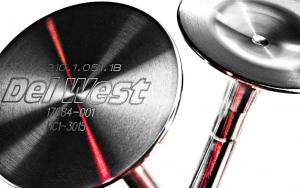
To handle such high stresses, intake and exhaust valves increase in
size, 46.8mm (from 43.5mm) and 38.2mm (from 34.5mm), respectively. Both
are also now titanium instead of steel (a method previously only used on
“R” models) and are actuated by rocker arms coated in polymeric-like
carbon (PLC), a process originally developed for the aerospace industry
which greatly reduces friction (it’s a coating similar to the
diamond-like coating seen on many high-performance fork stanchions).
An interesting trick Ducati has employed on the 1199 is the use of
what they call an “auto-decompressor” to make the engine turn over with
less effort from the starter. A flyweight at the end of each exhaust cam
gear retracts at super-low speed to rotate a protrusion from the
concentric side of the cam, thus creating just enough valve lift to
relieve the pressure on the piston for easy startup. If you’ve ever had
the pleasure of starting a Ducati, you’ve felt that anxiety just as you
press the starter button as the engine struggles to turn over. The
auto-decompressor alleviates that worry, and as a side benefit also
allows the use of a much smaller (read: lighter) starter and battery.
 This
CAD drawing reveals the desmodromic valve actuation and the chain/gear
assembly that drives them. Note also the “auto-decompressor” on the end
of the exhaust camshaft. It opens the valve slightly at tick-over to
ease startup. This
CAD drawing reveals the desmodromic valve actuation and the chain/gear
assembly that drives them. Note also the “auto-decompressor” on the end
of the exhaust camshaft. It opens the valve slightly at tick-over to
ease startup.
|
Of course, actuating those valves is none other than the desmodromic
mechanical system Ducati has sworn by for ages. Now, with the higher
engine speeds precise valve movement is more important than ever, and
Ducati feels as though it’s situations like this that emphasize the
importance of mechanical valve actuation over valve springs. However,
instead of belt-driven camshafts, Ducati is bucking with tradition and
relying on a combination chain/gear setup. According to Ducati, this is
the best way to precisely control timing of the sharp cam profiles,
especially at high rpm. As a side bonus, this also helps extend the
length of routine service intervals. Now valve adjustments are required
every 15,000 miles, with oil changes at 7500 miles (racetrack usage will
shorten those numbers). Don’t expect to see this tech trickle down to
air-cooled Ducs, however – those models don’t rev high enough to warrant
a switch.
Down Low
With such large pistons spinning at high rpm, the Superquadro units
feature double-ribbed undercrowns for improved strength and reduced
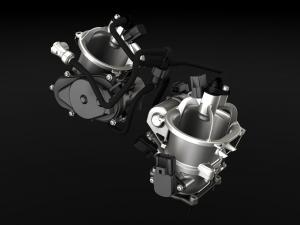
friction. The correct combination of air and fuel is fed to these
massive cylinders via equally massive throttle bodies, measuring an
equivalent diameter of 67.5mm. For perspective, the 1198’s measure
63.9mm! Each throttle body is actuated electronically via Ride-by-Wire
technology, and feeds two injectors; one underneath the butterfly for
better low-speed response and one positioned directly atop for outright
power. The use of Ride-by-Wire technology also enables the
implementation of ride modes and traction control, but Ducati is keeping
those electrical secrets close to heart until the bike’s unveiling.
As
far as the architecture of the engine is concerned, the Superquadro
retains the 90-degree L orientation as seen on all Ducati V-Twins, only
this one is rotated backwards around the crankcases a further six
degrees until the front cylinder is 21 degrees from horizontal. Apart
from moving the front cylinder 32mm closer to the front wheel (compared
to the 1198) and improving weight distribution, this also allows the
proper positioning of the cylinder head attachment points for the
monocoque frame. Inside the engine, vacuum die-casting technology first
used on the 1098R is used again to save weight, ensure consistent
crankcase wall thickness and increase strength. Another carryover
material used on the 1199 is magnesium alloy for the primary-drive
casing, clutch casing and outer cover, sump and cam covers.
In our preview story earlier, we mentioned Bruno de Prato’s claim
that Ducati was ditching the crankcase roller bearings that have been in
use for over 20 years in favor of plain, or “shell” bearings currently
employed by the Desmosedici RR engine in MotoGP. Turns out he was right.
This enables larger diameter crank journals which makes for a more
rigid and durable bottom end, suitable for the Superquadro’s power
output. Bearings are force-fed oil from internal drillings within the
main bearing pillars and that oil is sucked back into the sump via
vacuum pump, technology taken straight from the MotoGP program. The pump
is driven by the main oil-pump shaft and effectively maintains constant
vacuum in the crankcase area below the pistons, reducing pressure
during the cylinder’s down strokes and controlling the engine’s
“breathing.”
 Vacuum
die-casting technology is used on the crankcase to ensure wall
thickness, save weight and increase strength. It’s a technology first
used on the 1098R. Vacuum
die-casting technology is used on the crankcase to ensure wall
thickness, save weight and increase strength. It’s a technology first
used on the 1098R.
|
And while we’re on the subject of breathing, Ducati was able to
achieve this power while still meeting ever-stringent emission
requirements. One of the methods of achieving this is the introduction
of a secondary air system that helps complete the combustion of unburned
hydrocarbons. Through the use of lambda and throttle position sensors,
the ECU detects specific conditions and, if needed, opens a valve in the
main airbox to a reed valve in each cylinder head. Ultimately, this
fresh air is routed to the exhaust valve at its hottest point, enhancing
the burn environment and combusting any unburned fuel.
Attention wasn’t just given to the engine, however. An all-new
gearbox features stronger, larger-diameter gears to cope with the
increase in power. A bigger shock is Ducati’s switch to a “wet” oil-bath
clutch after years of sticking with the dry clutch design. The design
is based closely on the Multistrada and Diavel units and features a
slipper function to prevent wheel-hop under hard braking or quick
downshifting.
 An
all-new transmission is mated to the Superquadro engine utilizing
stronger, larger-diameter gears to withstand the increase in power.
Interestingly, in the interest of weight and optimal stiffness, Ducati
chose not to equip the 1199 Panigale with a cassette-type transmission. An
all-new transmission is mated to the Superquadro engine utilizing
stronger, larger-diameter gears to withstand the increase in power.
Interestingly, in the interest of weight and optimal stiffness, Ducati
chose not to equip the 1199 Panigale with a cassette-type transmission.
|
Too Slow. Not.
Apart from the above information, here are some other interesting
tidbits about the Superquadro. First seen on the the 1200 Multistrada
and new 848 Streetfighter, Ducati utilized an 11-degree valve overlap to
maximize torque output at the expense of top-end power. With the
Superquadro, however, a 45-degree overlap is used to squeeze out every
last bit of power.
Overall, the dimensions of the Superquadro engine are more compact
than the 1198, though it’s slightly taller due to the deeper oil sump
needed for heavy braking. Direct weight comparisons between old and new
are harder to measure, as the new powerplant is reinforced in order to
handle the increased demands of being the main stressed member of the
monocoque chassis. Ducati insists on measuring the overall weight of the
complete motorcycle, which it claims will be lighter than the outgoing
1198.
 The
Superquadro engine features a vacuum pump driven by the oil pump shaft,
a trick used in MotoGP. This pump maintains constant crankcase vacuum
below the pistons, which helps the engine “breathe.” The
Superquadro engine features a vacuum pump driven by the oil pump shaft,
a trick used in MotoGP. This pump maintains constant crankcase vacuum
below the pistons, which helps the engine “breathe.”
|
Despite the MotoGP team experimenting with seamless shift technology,
Ducati denies that this was even considered in the design of the 1199
Panigale. The company also denies even considering the use of a V-Four
engine configuration like rival Aprilia and the RSV4 Factory. According
to Claudio Domenicali, Ducati General Manager, “We still consider the
Twin the best option when you come to offer the ‘Ducati feeling,’ which
is strongly based on light weight and torque.”
And to answer a question many are surely wondering, Ducati denied the
prospect of the Superquadro engine being used on future models. Seeing
as how it serves as the main stressed member of the frame, that would
mean future Ducatis would also need to be completely redesigned to
support a monocoque chassis. Possible? Sure. Likely? Probably not. But
when it comes to the folks in Borgo Panigale, one learns to never say
never.
 Ducati
claims the new Superquadro engine is more compact than that of the
1198, though the deep oil sump of the Super-Q makes it taller than the
1198 mill. Ducati
claims the new Superquadro engine is more compact than that of the
1198, though the deep oil sump of the Super-Q makes it taller than the
1198 mill.
|
As we mentioned in the beginning, complete details about the rest of
the 1199 Panigale will be revealed at the EICMA show in Milan next
month.



1 comments :
Post a Comment