
More than 20,000 Multistradas have been sold over just 30 months, which is a sizeable number for a company that sells only 40,000 bikes a year. And of the various MTS models, it’s the travel-oriented S Touring version that sells best.
And of critical importance to Ducati’s long-term solvency is that the MTS is the first Ducati for about 80% of its owners. It is greatly expanding the appeal of what Ducati means to consumers.

The above is important to understanding why the long-legged Duc has been given an overhaul after less than three years on the market. The list of items new or retooled is extensive: cylinder heads, windshield, fairing, suspension, wheels, traction control and ABS. Ducati says the goal of the 2013 model is to further develop the bike’s touring ability without compromising its four-motorcycles-in-one concept.
Two new features on the 2013 Multi fight for the spotlight: a revised engine and a semi-active suspension. Since the “Skyhook” suspension is available only on upmarket S-class Multis and the motor mods apply to all Multistradas, we’ll begin in the engine room.
Ducati did an amazing job converting its 1198cc superbike V-Twin into a much more streetable mill for use in the MTS and, later, the Diavel. Its key modification was reducing valve overlap from the hi-po superbike’s 41 degrees to just 11 degrees, hence its “Testastretta 11°” nomenclature. However, fueling at low revs was a mite lumpy, especially in Sport mode, so Ducati engineers made three key changes to create the new “Testastretta 11° DS.”
 Supplementing
the Multistrada’s touring theme is the addition of a Granturismo
version. It boasts 20mm-higher bars, a wider and taller windscreen,
touring seats, crash bars and LED driving lights, plus larger saddlebags
and a 48-liter top case with integral backrest. It will retail for
$21,995 when it hits North American dealers in Q1 of 2013. Supplementing
the Multistrada’s touring theme is the addition of a Granturismo
version. It boasts 20mm-higher bars, a wider and taller windscreen,
touring seats, crash bars and LED driving lights, plus larger saddlebags
and a 48-liter top case with integral backrest. It will retail for
$21,995 when it hits North American dealers in Q1 of 2013. |
The result of these tweaks is a 5% boost in peak torque to 91.8 ft-lb, and a Ducati-supplied dyno chart shows a slight bump in power across nearly the entirety of its pull. Ducati also claims a 10% increase in fuel economy at 55 mph.
More importantly, the DS now responds much cleaner at low revs, aiding rider confidence while expanding the usable range of its powerband. Horsepower remains at a claimed 150 crankshaft horsies (or about 132 hp at the wheel). Power delivery and output is varied via four riding modes (Sport, Touring, Urban and Enduro).
 Don’t
care about touring? Then order up this 1200 S Pike’s Peak tribute
edition that eschews saddlebags and a centerstand for carbon-fiber
components, pinstriped forged-aluminum wheels, bespoke paint and a
red-stitched seat, plus a Termignoni exhaust canister. It shares the
Granturismo’s $21,995 MSRP. Don’t
care about touring? Then order up this 1200 S Pike’s Peak tribute
edition that eschews saddlebags and a centerstand for carbon-fiber
components, pinstriped forged-aluminum wheels, bespoke paint and a
red-stitched seat, plus a Termignoni exhaust canister. It shares the
Granturismo’s $21,995 MSRP. |
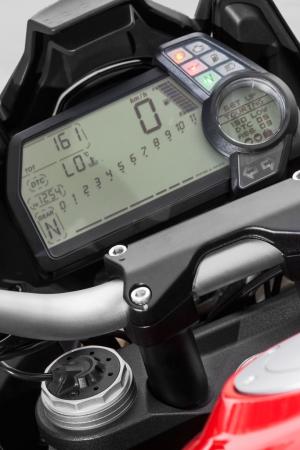
Upgrading to the S Touring version ($19,995) gets several important additions, including removable and lockable saddlebags, a centerstand and heated grips. But most interesting is the Skyhook semi-active suspension that replaces ordinary but fully adjustable suspenders on the base version.
Ducati Skyhook Suspension (DSS) is a high-tech suspension system similar to BMW’s new HP4 using Sachs electronic solenoid valves in the left fork leg and the shock to actively alter damping circuits depending on inputs such as road speed, brake application and four accelerometers placed around the bike. The vertical accelerometers on the lower triple clamp and rear subframe transmit “sprung” data, while sensors on a lower fork leg and the swingarm provide unsprung info.
 The
Multistrada 1200 S Touring can be had in traditional Ducati red or the
matte silver of our test bikes. Note the windshield in its raised
position. The
Multistrada 1200 S Touring can be had in traditional Ducati red or the
matte silver of our test bikes. Note the windshield in its raised
position. |
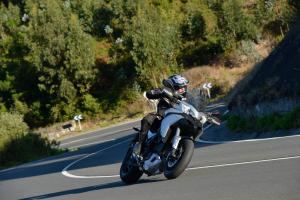
The Proof Is In the Ride Pudding
To test out the new MTS, Ducati invited us to sample the S Touring model in the hills and picturesque coastline surrounding Bilbao, Spain.
 Bilbao,
Spain made a nice backdrop for the 2013 Multistrada launch. The wild
Frank Gehry-designed Guggenheim museum (former home of the “Art of the
Motorcycle” exhibition) is visible on the left. Bilbao,
Spain made a nice backdrop for the 2013 Multistrada launch. The wild
Frank Gehry-designed Guggenheim museum (former home of the “Art of the
Motorcycle” exhibition) is visible on the left. |
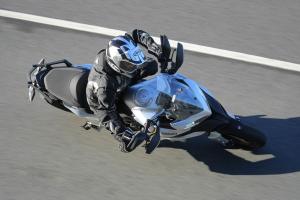 First impressions are of a very narrow waist, especially for a
sport-touring-esque rig. The first bike I rode was fitted with an
optional low seat that makes 6.7 inches of suspension travel 1-inch
easier to manage for short legs than the stock seat placed 33.5 inches
high. The low version is standard in Asian markets and is a good choice
for shorter riders, but larger pilots might find the rear section tilts
upward uncomfortably.
First impressions are of a very narrow waist, especially for a
sport-touring-esque rig. The first bike I rode was fitted with an
optional low seat that makes 6.7 inches of suspension travel 1-inch
easier to manage for short legs than the stock seat placed 33.5 inches
high. The low version is standard in Asian markets and is a good choice
for shorter riders, but larger pilots might find the rear section tilts
upward uncomfortably. Scrolling through the ride modes and DTC settings is initially frustrating, as the system (controlled by switches on the left handlebar) isn’t particularly intuitive. That said, any owner will be able to figure them out after some miles in the saddle.
The efficacy of the Multi’s new windscreen was put to the test on a freeway section. It’s now 18mm taller, which helps deflect some wind over a rider’s body, but it’s the 43mm of extra width that notably improves airflow deflection, even if not to the barn-door levels of some sport-tourers.
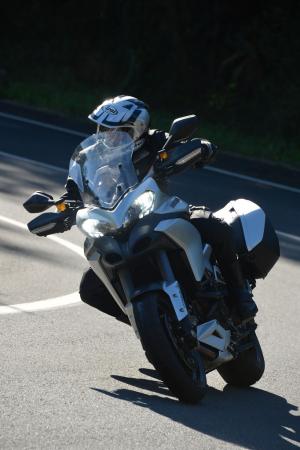 More impressive is the brilliantly simple windscreen adjuster that
can be operated with just one hand while riding. Greater wind protection
is available with the screen in its uppermost position, but I enjoyed
the non-turbulent air deflected when at the screen’s lowest position.
Long-haul comfort is good, with an ergonomically satisfying rider layout
that puts zero strain on wrists and provides generous legroom. Tall
riders might find the seat to be a bit short front to rear, which
reduces butt-position options.
More impressive is the brilliantly simple windscreen adjuster that
can be operated with just one hand while riding. Greater wind protection
is available with the screen in its uppermost position, but I enjoyed
the non-turbulent air deflected when at the screen’s lowest position.
Long-haul comfort is good, with an ergonomically satisfying rider layout
that puts zero strain on wrists and provides generous legroom. Tall
riders might find the seat to be a bit short front to rear, which
reduces butt-position options. Bilbao was drenched with rain the night before our ride, and the roads remained damp during the morning portion of our ride. This gave a good test for the Ducati Safety Pack, which really aided rider confidence on the unfamiliar wet roads. In Touring mode, DTC’s default setting is level 5, and it makes throttle reapplication in a corner stress-free.
Also aiding rider confidence is the engine’s newfound smooth response at the low end of the bar-graph tachometer. With the old bike, I’d be feathering the clutch to tame its lumpy low-end reaction on damp surfaces. This added bottom-end smoothness also significantly widens the engine’s powerband, allowing it to pull cleanly out of tight corners even in second gear. On that subject, the Multi’s gearbox isn’t what you could call slick, although the bikes had less than 400 miles and not once was a shift missed.
 Damp corner exits are no match for the Multistrada’s traction-control system and the V-Twin’s newfound gentleness at low revs. Damp corner exits are no match for the Multistrada’s traction-control system and the V-Twin’s newfound gentleness at low revs. |
 The Multistrada’s eager and torquey V-Twin is a willing accomplice when practicing your hooligan maneuvers. The Multistrada’s eager and torquey V-Twin is a willing accomplice when practicing your hooligan maneuvers. |
Speaking of brakes, the Brembo/Bosch combo is as good as it gets in this category. Radial-mount two-piece calipers up front deliver strong power without feeling too touchy – perfect for a streetbike. And no need to fear the linking effect when grabbing the front lever, as its influence on the rear binder is basically imperceptible.
 The Mulistrada’s somewhat odd appearance has become more mainstream over the years. The Mulistrada’s somewhat odd appearance has become more mainstream over the years. |
Conclusion
We already were big fans of Ducati’s liquid-cooled Multistrada, and the changes for 2013 significantly ups its appeal as both a sportbike and a touring sled. The semi-active suspension is a real advancement that will soon spread to many other motorcycles, and the smooth responsiveness of the new DS engine eliminates the biggest concern we had with the previous bike. So good is this new bike that I’d feel disappointed if I had recently purchased a 2012 MTS.
 The
Multistrada offers a combination of capable commuter, touring talent
and backroad blitzer that is unique in the motorcycle world. The
Multistrada offers a combination of capable commuter, touring talent
and backroad blitzer that is unique in the motorcycle world. |
In our Best of 2010 Awards, we observed the Multistrada “has the best combination of sport, touring and commuting that we’ve ever experienced, potentially paring down a three-bike garage to just two wheels.”
The above statement holds even more water with the introduction of the 2013 Multistrada. The only impediment to your consideration might be the $17K entry price. The updated ’Stradas will be available in North America early in 2013.
 The Multistrada can ably take you to roads both near and far. The Multistrada can ably take you to roads both near and far. |


1 comments :
This story is in Copyright violation. It was stolen in its entirety from Motorcycle.com
Post a Comment