If Honda
and Ducati received attention from the motorcycle press proportionate to
the number of motorcycles they actually sell, you would see 35 Honda or
Harley-Davidson reviews for every story about a Bologna V-Twin.
Instead, it's Ducati this, Ducati that, Ducati, Ducati, Ducati.
If the purpose of motorcycle publications was solely to "assist the
readership in making an informed decision" about what to buy -- as
Motorcycle.com subscriber Nesbit says -- there would be no point at all
in writing about Ducatis; they represent less than one percent of all
motorcycles sold in the United States. You almost have a better chance
of being struck by lighting than of purchasing one of maybe 1,000 1098
Superbikes that will be sold in the USA. That's about .6 percent of all
sportbikes sold here.
We
write about Ducatis -- and you read about them -- because they
represent an ideal of what the sporting Italian motorcycle should be. Of
the dozens of manufacturers that sell motorcycles here, only a small
number really seem to get what inspires riders when it comes to a look,
sound and feel. When you see a Ducati in the flesh, it has a distinctive
visual presence that makes you want to touch and ride the bike, born of
many elements; the marque's history, that beautiful air-cooled V-twin,
the painted steel trellis frame. How can you not want to read about it?
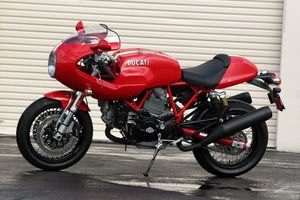
And how can you not want to read about one of the most beautiful motorcycles Ducati has made in recent times?
Especially
intriguing among Ducati's creations are the concept bikes that appeared
at the Tokyo Motor Show in 2003. Called the "Sport Classics", they were
three bikes with 1970s styling and the good-as-gold DS1000 two-valve
air-cooled motor. One was the gorgeous 1000LE Paul Smart replica,
another was the simplistic Sport 1000, and the final version was the
GT1000 roadster. The first two models had tasty-looking staggered dual
exhausts that looked great but precluded carrying a passenger.

For 2006, Ducati buyers world-wide were allowed to buy these three
bikes. The production versions were remarkably similar to the show
bikes, and they sold very well indeed: according to European
Correspondent Yossef Schvetz's test of the GT1000 last year, something
like 30 percent of Ducati's sales worldwide are of the Sport Classics
line. For 2007 the bikes return with just a few changes.
The
biggest change is that all three of these bikes are now equipped to
carry a passenger. So Ducati ditched the shotgun exhaust and single
shock, giving both Sport 1000 models the symmetrical swingarm and dual
shocks of the GT1000. Surprisingly, it hasn't detracted too much from
their classy good looks, and now you can bring a passenger along for the
ride.

For those of you who don't obsessively read every word written about
Ducatis, here's some quick low-down on the Sport 1000S. The heart of
this bike is that DS1000 motor, which first appeared in 2003, a
descendent of the first Pantah belt-driven cam motors that replaced
Ducati's first generation bevel-drive cam motors. It works its magic by
dint of almost every part from the old 900 motor getting a redesign, as
well as being bigger and receiving an extra sparkplug. For 2007, other
models in the Ducati line get an 1100cc version of this engine, but for
some reason the Monster and Sport Classics only get the 1000. Maybe
there's a whole warehouse full of the 1000cc pistons. Who knows? What we
do know is this motor makes 81.07hp on our Dynojetto di Motociclo.com,
with 61.67 foot-pounds of torque, and can rev to almost 9,000 rpm.

It
does this with the aid of Marelli electronic fuel injection and 45mm
throttle bodies, and gets the power to the back tire via a six-speed
gearbox and wet -- wet, I tells ya! -- clutch with hydraulic actuation.
No more people asking if there's something wrong with your clutch at
idle when they hear that dry-clutch clatter. Valve actuation is that
loveably-complicated but oh-so-precise Desmodromic system that eschews
springs to open and shut the two valves per cylinder. This year Ducati
revised their service manuals and only call for valve clearance
adjustments every 7,500 miles, which means starting in 2009, Ducati
mechanics' trucks, boats and stripper gratuities will be approximately
20 percent smaller.
| Living with a Duck |
|
If
there is one reason most cited by Ducati shoppers that keeps them from
becoming Ducati owners, it's probably the fear of high maintenance
costs. It's a well-justified fear, too; the air-cooled Ducati motors are
simpler to maintain than their four-valve, liquid-cooled
high-performance brethren, but the need to replace cam-drive belts and
swap two shims per valve still means an expensive service every 6,000
miles. This can cost as much as $1,000 twice a year or more for riders
who actually ride their bikes.
 Ducati has been trying to get service costs under control for many of
their models for some time now, and 2007 marks a major milestone in
their cost-cutting campaign. The service schedule is now greatly
simplified; the owner need only visit his shop for ritual demoney-fying
every 7,500 miles after the initial 600-mile service. Ducati has been trying to get service costs under control for many of
their models for some time now, and 2007 marks a major milestone in
their cost-cutting campaign. The service schedule is now greatly
simplified; the owner need only visit his shop for ritual demoney-fying
every 7,500 miles after the initial 600-mile service.
Gasp! This means that your Grandpa's advice to change engine oil
every 2,000 miles is being ignored. Instead, Ducati recommends using
full-synthetic Shell Advance Ultra 4, and it makes sense; synthetic
oil's main advantage over rock oil is that it resists breakdown for a
much longer time, so why not double the oil-change intervals? And fuel
injection can adjust itself enough so that it doesn't require attention
as frequently, so why not just check your chain and tire pressures
yourself and ride, ride, ride?
Your
personal Ducati mechanic may not be too thrilled about this development
and might tell you to ignore the factory recommendations and come in
every 3,000 miles to change oil, and every 6,000 to have belts and
valves checked. It certainly can't hurt to do that extra maintenance,
and it's also a good idea to give your vehicle a once-over frequently to
check tire pressure, fasteners, fluid levels, leaks, and so on. If you
can handle that, then you can change the oil and filter yourself, too,
although the DS motor has a second filter element that can be a hassle
to remove and clean.
 But if you want to just have The Man do your service for you, relax.
According to Ducati's suggested service pricing, all the services to
(but not including the 30k service) the 30,000-mile mark should run a
mere $1,833, not including sales tax on parts, figuring a $75 per hour
labor rate. This includes three valve adjustments and a cam belt
replacement, but not tires, brake pads, or chains. Not bad; most bikes
(even Japanese ones) usually cost over $2,000 in that same period to
maintain at a dealer. But if you want to just have The Man do your service for you, relax.
According to Ducati's suggested service pricing, all the services to
(but not including the 30k service) the 30,000-mile mark should run a
mere $1,833, not including sales tax on parts, figuring a $75 per hour
labor rate. This includes three valve adjustments and a cam belt
replacement, but not tires, brake pads, or chains. Not bad; most bikes
(even Japanese ones) usually cost over $2,000 in that same period to
maintain at a dealer. |

 For 2006, Ducati buyers world-wide were allowed to buy these three
bikes. The production versions were remarkably similar to the show
bikes, and they sold very well indeed: according to European
Correspondent Yossef Schvetz's test of the GT1000 last year, something
like 30 percent of Ducati's sales worldwide are of the Sport Classics
line. For 2007 the bikes return with just a few changes.
For 2006, Ducati buyers world-wide were allowed to buy these three
bikes. The production versions were remarkably similar to the show
bikes, and they sold very well indeed: according to European
Correspondent Yossef Schvetz's test of the GT1000 last year, something
like 30 percent of Ducati's sales worldwide are of the Sport Classics
line. For 2007 the bikes return with just a few changes.  For those of you who don't obsessively read every word written about
Ducatis, here's some quick low-down on the Sport 1000S. The heart of
this bike is that DS1000 motor, which first appeared in 2003, a
descendent of the first Pantah belt-driven cam motors that replaced
Ducati's first generation bevel-drive cam motors. It works its magic by
dint of almost every part from the old 900 motor getting a redesign, as
well as being bigger and receiving an extra sparkplug. For 2007, other
models in the Ducati line get an 1100cc version of this engine, but for
some reason the Monster and Sport Classics only get the 1000. Maybe
there's a whole warehouse full of the 1000cc pistons. Who knows? What we
do know is this motor makes 81.07hp on our Dynojetto di Motociclo.com,
with 61.67 foot-pounds of torque, and can rev to almost 9,000 rpm.
For those of you who don't obsessively read every word written about
Ducatis, here's some quick low-down on the Sport 1000S. The heart of
this bike is that DS1000 motor, which first appeared in 2003, a
descendent of the first Pantah belt-driven cam motors that replaced
Ducati's first generation bevel-drive cam motors. It works its magic by
dint of almost every part from the old 900 motor getting a redesign, as
well as being bigger and receiving an extra sparkplug. For 2007, other
models in the Ducati line get an 1100cc version of this engine, but for
some reason the Monster and Sport Classics only get the 1000. Maybe
there's a whole warehouse full of the 1000cc pistons. Who knows? What we
do know is this motor makes 81.07hp on our Dynojetto di Motociclo.com,
with 61.67 foot-pounds of torque, and can rev to almost 9,000 rpm.  Ducati has been trying to get service costs under control for many of
their models for some time now, and 2007 marks a major milestone in
their cost-cutting campaign. The service schedule is now greatly
simplified; the owner need only visit his shop for ritual demoney-fying
every 7,500 miles after the initial 600-mile service.
Ducati has been trying to get service costs under control for many of
their models for some time now, and 2007 marks a major milestone in
their cost-cutting campaign. The service schedule is now greatly
simplified; the owner need only visit his shop for ritual demoney-fying
every 7,500 miles after the initial 600-mile service. But if you want to just have The Man do your service for you, relax.
According to Ducati's suggested service pricing, all the services to
(but not including the 30k service) the 30,000-mile mark should run a
mere $1,833, not including sales tax on parts, figuring a $75 per hour
labor rate. This includes three valve adjustments and a cam belt
replacement, but not tires, brake pads, or chains. Not bad; most bikes
(even Japanese ones) usually cost over $2,000 in that same period to
maintain at a dealer.
But if you want to just have The Man do your service for you, relax.
According to Ducati's suggested service pricing, all the services to
(but not including the 30k service) the 30,000-mile mark should run a
mere $1,833, not including sales tax on parts, figuring a $75 per hour
labor rate. This includes three valve adjustments and a cam belt
replacement, but not tires, brake pads, or chains. Not bad; most bikes
(even Japanese ones) usually cost over $2,000 in that same period to
maintain at a dealer.


0 comments :
Post a Comment