
 Get ready for a serious comeback of two-strokes in
the near future with engines that can compete with four-strokes
head-to-head in emission cleanliness, fuel economy, and ride-ability,
all the while retaining power, size, and weight advantages over
four-strokes. Off-road and motorcross riders have long enjoyed the
benefits of two-strokes, which have evolved into highly reliable motors.
For you (American) street riders out there, two-strokes have been a
thing of the past, banned in the U.S. for their unclean emissions since
1985 (100cc and over).
Get ready for a serious comeback of two-strokes in
the near future with engines that can compete with four-strokes
head-to-head in emission cleanliness, fuel economy, and ride-ability,
all the while retaining power, size, and weight advantages over
four-strokes. Off-road and motorcross riders have long enjoyed the
benefits of two-strokes, which have evolved into highly reliable motors.
For you (American) street riders out there, two-strokes have been a
thing of the past, banned in the U.S. for their unclean emissions since
1985 (100cc and over).
Just when two-stroke fans had given up and bought old, clapped-out two-stroke street bikes, Honda is now poised to bring them back.
 The curved yellow valve rotates on a pivot to open and close the exhaust port; it is shown in the closed position.
The causes of high emissions of two-stroke engines are relatively simple, and are attributable to the basic way a two-stroke operates. There are two main factors which cause poor emissions: Incomplete combustion of fuel at low engine RPM, and expulsion of unburnt fuel out with the exhaust at high engine RPM, with both problems compounded by the fact that oil is injected into the motor to lubricate the crankshaft, and is then burnt off in combustion. The EXP-2 was designed to solve the first of these problems which occurs because, during the two-stroke cycle, fuel enters the cylinder through the intake port in the side of the cylinder, and pushes spent gases out of the exhaust port in the opposite cylinder wall at the same time. In doing this, the fuel and exhaust mix somewhat, causing some exhaust to remain in the cylinder with the incoming fuel.
 World sales figures
 Cut-away diagram of the exhaust valve
 Cut-away diagram of EP2 Motor
1. Fresh fuel (white) enters the combustion chamber, pushing the exhaust (grey) out the open exhaust valve on the opposite side of the cylinder.
2. The incoming fuel mixes with the exhaust, and some pockets of fuel are isolated within the exhaust. The exhaust valve closes and the compression of the mixture is increased as the piston travels upward.
3. The fuel/exhaust mixture is compressed and auto-ignites as the piston reaches the top of its stroke. This burns all of the fuel, and reduces the emission of unburnt hydrocarbons into the environment.
By eliminating misfiring, the motor actually burns much more of the fuel that it consumes.
At small throttle openings, a conventional two-stroke will start a repeating pattern of misfiring, which allows a large amount of unburnt gas and oil to be expelled directly into the atmosphere. At these low engine speeds, the amount of fuel entering the combustion chamber is small compared to the amount of exhaust remaining, which creates a mixture that is not ignited by the spark, and is expelled directly into the exhaust system. Each time this misfire occurs, the amount of fuel remaining in the cylinder increases, until it is great enough to be ignited by the spark. When it is ignited, the cylinder is again filled with exhaust and the cycle repeats itself.
By measuring cylinder pressure over time, this cycle can be seen as a pattern of regular large increases in pressure. The increases in pressure mark the points where the mixture burns; between these pressure peaks is the area where all of the fuel and oil are going out the pipe without burning, which is a major source of emissions and exhaust system contamination.
As can be seen from the graph below, this cycle occurs at low and medium loads during conventional two-stroke combustion.
 Plot
of cylinder pressure vs. time for conventional two-stroke at light and
slightly reduced loads. The vertical peaks are firing cycles, and the
area between peaks are misfires.
Plot
of cylinder pressure vs. time for conventional two-stroke at light and
slightly reduced loads. The vertical peaks are firing cycles, and the
area between peaks are misfires.By igniting the entire mixture without the use of a spark, the EXP-2 is able to burn all of the fuel and oil in the cylinder in every cycle, eliminating the misfiring cycle described above. By eliminating misfiring, the motor actually burns much more of the fuel that it consumes; this reduces the amount of unburned fuel and oil released into the atmosphere, which greatly decreases hydrocarbon emissions. The graph of cylinder pressure below illustrates the resulting constant pressure, which indicates that the fuel is burning on each cycle.
 Plot
of cylinder pressure vs. time for EXP-2 two-stroke at light load. The
smoothness of the graph indicates continuous regular combustion with no
misfiring.
Plot
of cylinder pressure vs. time for EXP-2 two-stroke at light load. The
smoothness of the graph indicates continuous regular combustion with no
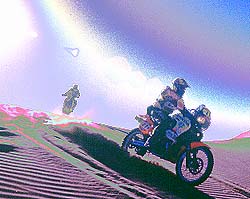
misfiring. Honda's riding team of Chuck Miller, Paul Ostbo and Greg Bringle finished 7th overall and first in class in the Baja 1000.
As a test for this technology, Honda built a 400cc single-cylinder bike for off-road and desert endurance racing. The 400cc single design was chosen because it has a large combustion chamber and a high piston speed, making for difficult burn characteristics; if the EXP-2 system works for this configuration, it will work for smaller piston engines. Fuel injection was also used for ease of setup and fuel measurement, although the system was designed to work with carbureted systems as well. The race results were very good even though the bike was not designed to win races, but to test new technology.
What all this boils down to is that the EXP-2 has about the same real-world performance as the 780, but with substantially better fuel economy and lower emissions.
When the dust settled, the EXP-2 had earned 5th overall and 1st in both the under 500cc and Experimental classes at the Granda-Dakar rally; 1st in the two-stroke class and 8th overall in the Nevada Rally last year, and 7th overall motorcycle at the Baja 1000.
Compared to Honda's current NXR780 four-stroke twin rally race bike, the EXP-2 has very si
 Check out a riding impression by our tech editor


0 comments :
Post a Comment