
How fast is it? The carbureted motocross TC250F we tested last year was fun to ride but didn’t quite have the raw power to hang with the Japanese motocross bikes through the gears, especially the remarkably powerful KX250F, and the engine in the TXCi is smoother yet. It doesn’t make much low-end torque, but its mid-range and top end are healthy, making it tractable and easy to ride.

Our TXCi hooked up well enough in the mud to get to the first turn in second place off a dead-engine start at a very muddy Cross-Country race. The smooth-pulling engine loves low traction situations! In good traction situations, however, the TXCi 250F will not quite keep up out of the starting gate with a Japanese 250F motocross bike.
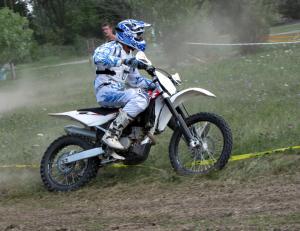 We tried a JD Jetting EFI control box and removed the spark arrestor
and end cap from the muffler to see if we’d get a little more power. We
know it’s not PC to do so, and the bike got noisier and wouldn’t be
legal for events requiring a spark arrestor, but it was still quieter
than a motocross bike. The JD fuel injection control box helped, letting
the EPA-tuned bike run richer. Technically we now had a ‘closed course
only’ racing motorcycle.
We tried a JD Jetting EFI control box and removed the spark arrestor
and end cap from the muffler to see if we’d get a little more power. We
know it’s not PC to do so, and the bike got noisier and wouldn’t be
legal for events requiring a spark arrestor, but it was still quieter
than a motocross bike. The JD fuel injection control box helped, letting
the EPA-tuned bike run richer. Technically we now had a ‘closed course
only’ racing motorcycle.We fiddled with EFI settings nearly every time we rode the bike. When testing in the Rocky Mountains, we could not make the bike run lean enough at high altitude with the JD box installed. At our normal test elevation (600-1000 ft) we had no problem, though constantly fiddling with the EFI controls seems old-fashioned compared to other EFI equipped bikes we’ve ridden lately that run well pretty much anywhere.
 Our biggest complaint about the TXCi was its fork performance, feeling both overdamped and undersprung. Our biggest complaint about the TXCi was its fork performance, feeling both overdamped and undersprung. |
With the engine running crisp, suspension tuning became our top priority. The Kayaba fork was stiff and unresponsive over small impacts, yet blew through its travel easily on G-outs, abrupt endurocross obstacles and on the motocross track. Rocky trails caused the bike to deflect, and we fiddled with compression and rebound settings throughout the test. We finally backed off the compression to 18 clicks and rebound to 20. The fork simply needs to be re-valved and re-sprung to suit our style of riding. The Sachs rear shock, on the other hand, felt under-damped in both compression and rebound. The wallowy feel upset the turning abilities of the bike and had us scratching our heads while we spun the clickers to find a setting that was not too harsh. Our testers raved about the overall handling of the TC250F motocross bike last year, and we knew from our test of the Husky TC250F motocross bike that these things will carve turns like a Suzuki when properly set up.
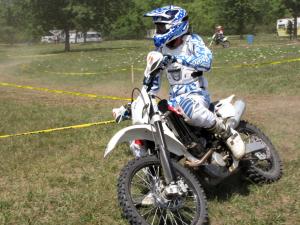 The TXCi is held back in turns by the oversized gas tank, with its
extra capacity carried in an evil looking hump. The Husky has excellent
brakes and an otherwise flat seating position, so it’s easy to
aggressively slam into a turn with your weight really far forward. Every
one of our testers, three of them Pros, cursed the gas tank at least
once. The Husky’s ergonomics are otherwise good, slim and with a
comfortable distance between the seat, pegs and handlebars. The seat
height itself is quite tall, which frustrated shorter riders on
technical trails and the endurocross track.
The TXCi is held back in turns by the oversized gas tank, with its
extra capacity carried in an evil looking hump. The Husky has excellent
brakes and an otherwise flat seating position, so it’s easy to
aggressively slam into a turn with your weight really far forward. Every
one of our testers, three of them Pros, cursed the gas tank at least
once. The Husky’s ergonomics are otherwise good, slim and with a
comfortable distance between the seat, pegs and handlebars. The seat
height itself is quite tall, which frustrated shorter riders on
technical trails and the endurocross track. The TXCi, like all Huskys, is quite easy to service and maintain. There’s lots of room around the engine, the suspension linkage is intelligently designed, and the battery and air filter are easy to access. Even engine oil and filter changes are a breeze. Overall component quality is good, though the plastics start showing their age quickly.
 Last year we really liked the TC250F, and with just a few more ponies
we would have loved it. Based on that test, and since this bike is
targeted directly at the cross-country demographic, we expected great
things from the TXCi. After spending so much time aboard the TXCi,
however, we unanimously agreed we’d rather race the TC model. The TXCi
is a lightweight, fun to ride electric-start trail bike that has a
successful competition record, but out of the box the TC is a better
race bike.
Last year we really liked the TC250F, and with just a few more ponies
we would have loved it. Based on that test, and since this bike is
targeted directly at the cross-country demographic, we expected great
things from the TXCi. After spending so much time aboard the TXCi,
however, we unanimously agreed we’d rather race the TC model. The TXCi
is a lightweight, fun to ride electric-start trail bike that has a
successful competition record, but out of the box the TC is a better
race bike. If we owned a TXCi 250F we’d wake it up with the JD fuel injection tuning kit and use an aftermarket pipe, just like the Husky race team does. We’d also use the smaller motocross fuel tank unless we absolutely had to have longer fuel range. We’d lower the gearing a little and get our suspension dialed in for the aggressive blend of cross-country, endurocross and motocross racing we normally enjoy.
 We
had fun racing our TXCi on grass tracks, where the smooth powerband,
excellent brakes and lightweight feel helped it turn great lap times. We
had fun racing our TXCi on grass tracks, where the smooth powerband,
excellent brakes and lightweight feel helped it turn great lap times. |
After those modifications we’d have a machine we’d like even better than the TC (thanks to the great electric starter!) and we’d race it anywhere, anytime. A pre-2012 Husqvarna press release mentioned improvements on next year’s model in all the areas we’ve noted, so we bet the 2012 model of the TXCi 250F will truly live up to its race winning potential.
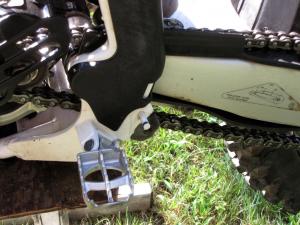
 The
clutch feel and transmission are great, but a few more teeth on the
rear sprocket would certainly make the bike easier to ride. Thanks to
the six-speed transmission we’d gladly trade some top-end speed for less
clutch abuse in technical sections. The
clutch feel and transmission are great, but a few more teeth on the
rear sprocket would certainly make the bike easier to ride. Thanks to
the six-speed transmission we’d gladly trade some top-end speed for less
clutch abuse in technical sections. |
Thank you Husqvarna Canada and Trevor Wideman for supplying our test bike!


0 comments :
Post a Comment