Fontana, CA -- Take one part novice and one part
professional instruction; mix together thoroughly with street bike and
marinade for approximately two hours. Remove novice from street bike and
add one turnkey drag bike. Bake rear tire for two to four seconds and
then let mixture settle for 30 to 60 seconds. Set novice and turnkey
drag bike at starting line. Turn on timing lights; apply full throttle
then release clutch immediately to inject 165 horsepower. Hold full
throttle for the length of a quarter mile or 9.96 seconds. Remove
jubilant novice and garnish with NHRA license.
That's a recipe that just about anyone with $31,249.00 and most of
the above ingredients can use to accomplish the same results or better,
thanks to the Harley-Davidson Motor
Company
and their CVO Division. Custom Vehicle Operations or CVO as it's called
back in Milwaukee, "creates low-volume, custom motorcycles produced by
skilled technicians in special assembly areas at the Harley-Davidson
plants in York, PA and Kansas City, MO." A long winded way of saying
that this division has a single focus of bringing customization inside
of the giant that is Harley instead of letting customers walk away and
into the ever burgeoning market segment that is customizing.

Earlier this year Harley unveiled the
new for 2006, VRXSE Screamin' Eagle Destroyer. A closed-course only
motorcycle based on the 2006 VRSCA V-Rod chassis but designed
specifically for drag racing. Even though Harley touts the Destroyer as a
`Pro-Level Drag Bike', they make the distinction that "the goal is to
bring grass-roots racing to dealerships and riders alike", according to
Joe Nutt, CVO Project Leader for the Screamin' Eagle Destroyer. As
evidence of that, for 2006 there will be a dedicated AHDRA Pro class for
the Destroyer.
As
mentioned above, the drag bike for the `average guy' is rooted in the
'06 V-Rod and has a color option of Electric Orange which isn't too
dissimilar from the VRSCSE Screamin' Eagle V-Rod. But that's where the
similarities end. As one of the Destroyer engineers said, "It's a
different bike from the ground, up." How long did it take to massage an
out-of-the-box drag bike? Nine months from concept to completion. And
final design was graced with input from Matt Hines, crew chief for the
NHRA Pro Stock Bike champion Screamin' Eagle/Vance and Hines team.
Which, by the way clinched the 2005 NHRA POWERade Pro Stock Motorcycle
championship on Nov. 6 at Pomona, California. So, what really sets the
Destroyer apart from the pack, or at least makes it a narrowly focused
machine? For starters the heart of the beast is a 1,300cc (79cu.in.)
liquid cooled, V-Twin Revolution engine with 105mm cylinders that are
made of ultra-hard ductile iron and a stroked, 75mm crankshaft. Forged
pistons help create a 14.0:1 compression ratio. Cylinder heads are CNC
ported; the valves, valve seats, springs and keepers are all competition
grade and designed to complement the high-lift, high-duration cams. The
heavily modified motor inhales through 58mm throttle bodies that
utilize tuned velocity stacks in lieu of an air cleaner.
An MTC multi-stage lock up clutch
handles harnessing the power that this dragon produces and puts the
ponies to a transmission that has a modified input, actuator and output
shaft assembly which works with an electric-over-air shift system. Final
drive is a 530 DRZ chain. It's the same chain that the Vance and Hines
drag racing team uses.
A combination of things that you can
and can't see further distinguishes this orange demon from its V-Rod
relatives. Like the programmable, multi-mode shift light and a two-stage
launch box (not lunch box) that's linked to the shift lever. Speaking
of being programmable and invisible, the Destroyer will be shipped with a
Screamin' Eagle Race Tuner that you can use to play with the ECM. A
digital tach/LED shift light is about the only indication of what's
going on.

To
really give it that `drag racer look', Harley has adorned the bike with
a wheelie bar, a special swingarm with custom rear-axle adjusters,
solid rear struts and the mother of all drag distinguishing goodies: a
big, square slick for the rear and a skinny slick up front. The rear
tire is a 7-inch x 25-inch Dunlop Screamin' Eagle, while the "other one"
is a 3-inch x 18-inch slick that may last a lifetime because it hardly
ever touches the tarmac. Both tires can be purchased from your local
Harley dealer but more importantly they're in stock, according to Joe
Nutt. Finishing touches include forward race-position drag handlebar and
risers, drag racing controls of which the most notable is the button
that says SHIFT, an emergency shut-off tether, rear-set (as in so
rear-set that they're mounted on the swingarm) footpegs and a race seat
with a high-rise cushion. One of the most enticing comments about this
bike came from Gene Thomason, who said: "With proper care this bike can
go a whole season without being torn down."
All this stuff sounds neat-o but what
would it be like to ride one? MO was invited to find out just what
Harley means by a turn-key, non-street legal, sub 10-second drag racing
motorcycle. A cool, rain threatened day greeted us at the California
Speedway Drag Strip in Fontana, California for what would be to some in
attendance, their first time ever down the quarter mile. I was one of
those. Never having been less than 10 feet from a drag strip, let alone
racing on one, some instruction would be necessary at least as far as
Harley-Davidson was concerned. To fill the shoes of instructor Harley
chose seasoned drag racer Gene Thomason who is more than qualified as he
routinely blasts down the strip on 200 horsepower Pro Gas drag bikes.

The
day would start with instruction on how to approach the burn out box,
do a burn out, approach the staging box, stage one and stage two lights
on a pro light tree, go down the strip straight and exit the strip once
the run is over. It sounds simple in premise doesn't it? Harley isn't so
eager to get the word out about the Destroyer that they would just
plunk any old editor in the saddle of a purpose built, 165 hp motorcycle
and let `em go. No sir, not at all. We had to prove to the Harley folk
and Gene that we would be able to grasp the concept of drag racing
before riding the real deal. And in order to do that Harley provided
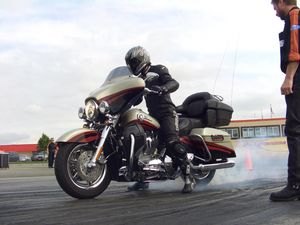
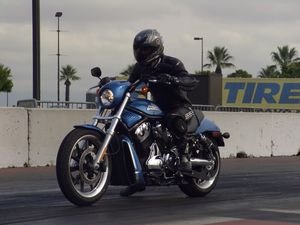
V-Rods, Screamin' Eagle V-Rods, Screamin' Eagle Fat Boys and of all
things Screamin' Eagle Ultra Classic Electra Glides. Scoff if you will
at the idea of launching these street machines down the strip but one
can and must learn the basics of what seems like such a simple form of
racing.

For instance, approaching the burn out
section or "box", you should already be looking down the track and
picking a point in the distance to begin lining yourself up, all the
while being conscious of not moving the bike through the water that's
used to help initiate the burn out. After positioning the bike in front
of the water my next step was to ease the bike backwards so the rear
tire would be in the water. The entire time you're backing up you never
want to lose your gaze down the strip. Looking anywhere other than
straight down at your feet will cause you to be crooked. Once I was
certain that I had the rear tire in the water I then eased the bike
forward approximately four feet to position for the burn out. Next in
the process is getting the bike into second gear (not first as many
would assume), holding the front brake with all four fingers, holding in
the clutch and revving the engine to around 7,000rpm for the V-Rods and
around 5,000rpm for the Electra Glides by using that fifth digit called
the thumb. Now you're ready to release the clutch, shove the front end
into the ground and keep the revs up.
Again,
this all sounds simple until you attempt to do it the right way, the
right way being to never load the rear tire. You'd be surprised how few
people can do it correctly. It's a tiny symphony of actions that require
practice. A burn out should be between two to four seconds. After
completing the burn out, approaching the staging lights is the next
order of business. Seemingly, this should be yet another simple act. On
this day we would be using what is called a "pro tree." The first action
is completely in the racer's control as the first staging light is lit.
Nothing will happen until he or she causes the second staging light to
go off by literally inching forward. At this point all bets are off and
the racer is at the mercy of the starter. The starter can trigger the
green light in as little as one second after the racer has activated the
second staging light. Though typically the window is one to five
seconds.
Just about everyone has seen the
configuration of lights at a drag strip: three yellows and a green on
the right and left and a single red light at the bottom. The typical
countdown, so to speak, is yellow, yellow, yellow, green. In a pro tree
scenario all the yellows will light at once and then the green. Gene's
instruction to us drag race hopefuls was to drop the clutch and go once
you see all yellows light up. The bike and rider reaction time will be
such that once the bike moves the green light should be up. It's just
one more thing to catalog in the "easier than it sounds" section. Should
the rider do all this as planned the only thing to do after that is
keep the throttle open, shift and go straight. Somewhere in the next
nine to 14 seconds you can expect to reach the end of the quarter mile.
"It was over before I knew it!"

After completing 15 to 20 passes on
various street bikes it was time to move onto the big dog. Gene needed
to give additional instruction to us for riding the Destroyer. The
general principles were the same but the Destroyer, being a true drag
bike, has a variety of nuances. For example, the "stutter box", as it's
commonly referred to, is the programmable rev limit depending on whether
the clutch is disengaged or engaged. With the clutch lever pulled in
the bike could only rev to 7,500rpm. Once the clutch is released the
engine will go to full rev, somewhere around 10,000rpm. And again, this
can be programmed to the racer's liking.
While
on the subject of the clutch one of Gene's most important pointers was
that we release the clutch immediately. No slipping of the clutch
allowed. This serves a two-fold purpose: it prevents additional heat
from being built into the clutch and is the only way to get a good
launch from the line. Just a few more tidbits were covered before our
first soft launch: lay across the "gas tank" in full drag racer mode,
utilize the LED shift light, keep the throttle on and go straight. All
other lessons learned were applied to these few new instructions and it
was time to line up.
The first pass was what's called a soft
launch. In other words, the goal was to essentially roll away from the
line and continue to build speed through first gear. After first gear at
full throttle, we could hold the throttle open and shift when the shift
light said it was time, with engine speed around 8,000rpm. Call it a
soft launch if you want but there's nothing soft about the way this
liquid cooled, 1,300cc eagle screams. Since there really isn't anyway to
describe something like riding a dedicated drag bike for the first few
times a lot of cliche have to be applied. One to start with is: "It was
over before I knew it!"

 Earlier this year Harley unveiled the
new for 2006, VRXSE Screamin' Eagle Destroyer. A closed-course only
motorcycle based on the 2006 VRSCA V-Rod chassis but designed
specifically for drag racing. Even though Harley touts the Destroyer as a
`Pro-Level Drag Bike', they make the distinction that "the goal is to
bring grass-roots racing to dealerships and riders alike", according to
Joe Nutt, CVO Project Leader for the Screamin' Eagle Destroyer. As
evidence of that, for 2006 there will be a dedicated AHDRA Pro class for
the Destroyer.
Earlier this year Harley unveiled the
new for 2006, VRXSE Screamin' Eagle Destroyer. A closed-course only
motorcycle based on the 2006 VRSCA V-Rod chassis but designed
specifically for drag racing. Even though Harley touts the Destroyer as a
`Pro-Level Drag Bike', they make the distinction that "the goal is to
bring grass-roots racing to dealerships and riders alike", according to
Joe Nutt, CVO Project Leader for the Screamin' Eagle Destroyer. As
evidence of that, for 2006 there will be a dedicated AHDRA Pro class for
the Destroyer.

 For instance, approaching the burn out
section or "box", you should already be looking down the track and
picking a point in the distance to begin lining yourself up, all the
while being conscious of not moving the bike through the water that's
used to help initiate the burn out. After positioning the bike in front
of the water my next step was to ease the bike backwards so the rear
tire would be in the water. The entire time you're backing up you never
want to lose your gaze down the strip. Looking anywhere other than
straight down at your feet will cause you to be crooked. Once I was
certain that I had the rear tire in the water I then eased the bike
forward approximately four feet to position for the burn out. Next in
the process is getting the bike into second gear (not first as many
would assume), holding the front brake with all four fingers, holding in
the clutch and revving the engine to around 7,000rpm for the V-Rods and
around 5,000rpm for the Electra Glides by using that fifth digit called
the thumb. Now you're ready to release the clutch, shove the front end
into the ground and keep the revs up.
For instance, approaching the burn out
section or "box", you should already be looking down the track and
picking a point in the distance to begin lining yourself up, all the
while being conscious of not moving the bike through the water that's
used to help initiate the burn out. After positioning the bike in front
of the water my next step was to ease the bike backwards so the rear
tire would be in the water. The entire time you're backing up you never
want to lose your gaze down the strip. Looking anywhere other than
straight down at your feet will cause you to be crooked. Once I was
certain that I had the rear tire in the water I then eased the bike
forward approximately four feet to position for the burn out. Next in
the process is getting the bike into second gear (not first as many
would assume), holding the front brake with all four fingers, holding in
the clutch and revving the engine to around 7,000rpm for the V-Rods and
around 5,000rpm for the Electra Glides by using that fifth digit called
the thumb. Now you're ready to release the clutch, shove the front end
into the ground and keep the revs up.
 After completing 15 to 20 passes on
various street bikes it was time to move onto the big dog. Gene needed
to give additional instruction to us for riding the Destroyer. The
general principles were the same but the Destroyer, being a true drag
bike, has a variety of nuances. For example, the "stutter box", as it's
commonly referred to, is the programmable rev limit depending on whether
the clutch is disengaged or engaged. With the clutch lever pulled in
the bike could only rev to 7,500rpm. Once the clutch is released the
engine will go to full rev, somewhere around 10,000rpm. And again, this
can be programmed to the racer's liking.
After completing 15 to 20 passes on
various street bikes it was time to move onto the big dog. Gene needed
to give additional instruction to us for riding the Destroyer. The
general principles were the same but the Destroyer, being a true drag
bike, has a variety of nuances. For example, the "stutter box", as it's
commonly referred to, is the programmable rev limit depending on whether
the clutch is disengaged or engaged. With the clutch lever pulled in
the bike could only rev to 7,500rpm. Once the clutch is released the
engine will go to full rev, somewhere around 10,000rpm. And again, this
can be programmed to the racer's liking.


0 comments :
Post a Comment