
Triumph, better known for its hooligan-making naked roadster Speed Triple or its GS-inspired big trailie Tiger, wasn’t a name that surfaced much in cruiser circles. But that changed in 2004 with the introduction of the Rocket III, powered by a monstrous 2,294 cc (140.0 cu in) inline-Triple. The big, rear-tire-roasting power cruiser had cruiser fans’ heads spinning. Then in 2009 the British bike maker again caught the attention of cruiser lovers with the introduction of the Thunderbird and its large-displacement (1597cc) vertical-Twin, a bike that impressed us so much that we named it our Cruiser of the Year in 2009.
However, before these bruisers burst onto the scene, Triumph already had a model entered in the cruiser genre.

The humble Triumph America is but a blip on the radar when cruiser riders gather to talk shop. Even within Triumph’s world the America sits quietly in the background while the sales-dominating Street Triple 675 (and R model) and other sports bikes steal the limelight. Admittedly, even we haven’t given the America much attention in the past 10 years. But a recent ride on a current model year America revealed that shoppers in the cruiser market shouldn’t overlook this cruiser-ish Brit bike.
 Despite
being a humble middleweight, the America has many features that make it
feel and look like a bigger cruiser. Part of that bigger bike appeal is
a very roomy, comfortable ergonomic layout. Despite
being a humble middleweight, the America has many features that make it
feel and look like a bigger cruiser. Part of that bigger bike appeal is
a very roomy, comfortable ergonomic layout. |
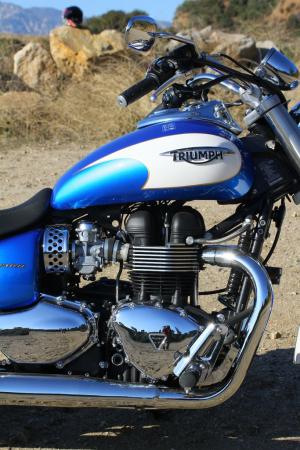 In a world of tha-thump-tha-thump-tha-thump V-Twins, the America’s smooth-running, fuel-injected,
865cc vertical-Twin is a unique break with cruiser engine tradition. If
you’re looking for a rumbling, raucous ride – one that causes the
entire bike to shudder – take note that the America’s 270-degree firing
interval has endowed the engine with a quiet-as-a-mouse character when
compared to most Harleys and many Japanese cruisers. But if you’re more
concerned with enjoying the scenery than about how many passersby are
noticing your thundering exhaust, then the gentle Triumph Twin deserves
your attention.
In a world of tha-thump-tha-thump-tha-thump V-Twins, the America’s smooth-running, fuel-injected,
865cc vertical-Twin is a unique break with cruiser engine tradition. If
you’re looking for a rumbling, raucous ride – one that causes the
entire bike to shudder – take note that the America’s 270-degree firing
interval has endowed the engine with a quiet-as-a-mouse character when
compared to most Harleys and many Japanese cruisers. But if you’re more
concerned with enjoying the scenery than about how many passersby are
noticing your thundering exhaust, then the gentle Triumph Twin deserves
your attention.The first-gen America rolled on cruiser-classic wire wheels, but the most current issue wears 12-spoke cast-aluminum wheels that project a more muscular appearance. Attached to the front wheel is a single 310mm brake disc clamped by a Nissin two-piston caliper, while a 285mm disc and Nissin two-piston caliper slow things from the back. The front caliper handily slows the bike from speed with crisp, authoritative braking action. Applying both calipers simultaneously to retard the America’s forward progress left me wishing that more cruisers in the market offered the same degree of feel and power as what the America provides.
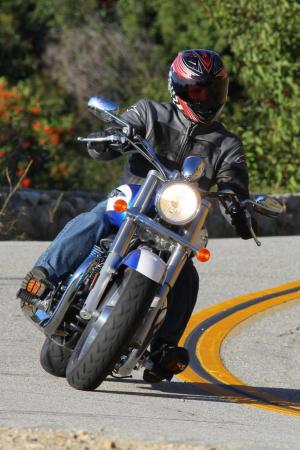
 With a chubby-looking front tire (130/90 x 16) the America doesn’t
strike the impression of a light-steering cruiser. And the 33.0-degree
rake, 5.62 inches of trail and rangy 63.6-inch wheelbase don’t exactly
scream “Snappy steering!” Despite these lazy figures the America is
anything but sluggish between turns – though the long wheelbase does
make tight-radius U-turns challenging at times.
With a chubby-looking front tire (130/90 x 16) the America doesn’t
strike the impression of a light-steering cruiser. And the 33.0-degree
rake, 5.62 inches of trail and rangy 63.6-inch wheelbase don’t exactly
scream “Snappy steering!” Despite these lazy figures the America is
anything but sluggish between turns – though the long wheelbase does
make tight-radius U-turns challenging at times.A notably wide, pull-back handlebar allows plenty of steering leverage, and once set into a corner the America is wonderfully stable and tracks accurately throughout the arc of a turn. While the America is a cruiser, it doesn’t suffer from ultra-restrictive lean angle clearance; it will drag a peg, but not as soon as you might expect.
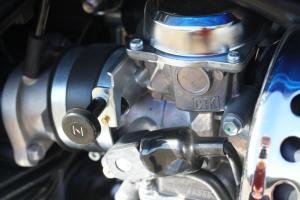
 Perhaps the America’s easily seen and inexpensive-looking
stamped-steel mount holding the speedo, or the poorly routed clutch
cable that brushes against the inside of the left header pipe, are what
remind of similar budget-saving tactics I’ve seen time and again on
other brands. On the other hand, the judicious use of rich chrome in all
the right places offsets some of the less attractive bits.
Perhaps the America’s easily seen and inexpensive-looking
stamped-steel mount holding the speedo, or the poorly routed clutch
cable that brushes against the inside of the left header pipe, are what
remind of similar budget-saving tactics I’ve seen time and again on
other brands. On the other hand, the judicious use of rich chrome in all
the right places offsets some of the less attractive bits.The analog speedo’s prominent placement is handy, mirrors provide a clear, useful field of view, and the clutch and brake lever have a 4-position reach adjustment. The layout of the rider environment is such that freeway jaunts of 50-plus miles click off with minimal effort. A small windscreen from the aftermarket would optimize comfort during time on the SuperSlab.
Finally, the large headlight, wide seat, wide handlebar and voluminous 5.1-gallon fuel tank all work to create the sensation you’re aboard a much larger motorcycle without making the America feel overly big or cumbersome.
With a base MSRP of $8299 ($8599 for two-tone colors) the Triumph America is comparably priced to Kawasaki’s Vulcan 900 Classic ($8299 – $8499) or Harley’s Sportster SuperLow ($7999 – $8499) and the V Star 950 ($8490) from Star.
 The
America hits most of the right cruiser notes but also offers something a
little different from the usual crowd of Harleys and Harley clones. The
America hits most of the right cruiser notes but also offers something a
little different from the usual crowd of Harleys and Harley clones. |
If you’re looking for something a little different without straying too far from the well-worn cruiser path, make sure to give the America a first, and then second look.


0 comments :
Post a Comment