
Whereas the Tiger 1050 is more of a sport-touring rig with long-travel suspension competing against the likes of Ducati’s Multistrada 1200, the new Tiger 800s are constructed to attack and conquer unpaved elements. To illustrate the measure of the newest Tiger’s off-road intentions Triumph invited a group of moto-journalists to a two-day ride that would challenge the Tigers on the street and in the dirt.
The morning of the event Triumph’s media liaison, Reg Kittrelle, shocked the attending press by announcing at breakfast we’d be spending the following night beneath the stars in a (insert gasp here) tent. “It’s all a part of the adventure-touring experience,” he said, attempting to assuage our discomfort at the idea roughing it for a night in the wilds of San Diego County.

Sure, the presence of Triumph North America CEO, Greg Heichelbech, kept the group of pampered moto-journalists from pooh-poohing the inhumane conditions, but apprehensions remained. Kittrelle avoided journalistic mutiny by announcing there’d be a catered BBQ accompanied by our selection of campfire beer.
 The spec sheet also reveals technical differences between the Tiger
and the F800GS such as 10mm more front suspension travel for the GS
compared to the Tiger XC, an 18-lb weight advantage for the BMW (7 lbs
compared to the standard Tiger), a 9-hp advantage for the Triumph but 4
ft-lbs more torque for the GS.
The spec sheet also reveals technical differences between the Tiger
and the F800GS such as 10mm more front suspension travel for the GS
compared to the Tiger XC, an 18-lb weight advantage for the BMW (7 lbs
compared to the standard Tiger), a 9-hp advantage for the Triumph but 4
ft-lbs more torque for the GS.What this information conveys regarding the better choice of motorcycle between the two competing brands I’m not sure, because, although I thunk it a good idea, Triumph didn’t share my wisdom when it came to providing an F800GS for us to ride. Hopefully, our requisition to BMW for an F800GS will soon be answered and we can complete this destiny.
 Short and sweet but also the truth. What gives the XC a taller seat
height (longer travel suspension and a larger front wheel) is also what
provides the XC with better off-road manners. In addition to the
aforementioned dirt-specific components, the XC gets an upgraded rear
shock that boasts 1.8 inches more travel than the standard Tiger, a
remote reservoir and rebound adjustability. The XC’s handlebar is also
2.7 inches wider, which goes a long way in providing better leverage
during off-road riding applications.
Short and sweet but also the truth. What gives the XC a taller seat
height (longer travel suspension and a larger front wheel) is also what
provides the XC with better off-road manners. In addition to the
aforementioned dirt-specific components, the XC gets an upgraded rear
shock that boasts 1.8 inches more travel than the standard Tiger, a
remote reservoir and rebound adjustability. The XC’s handlebar is also
2.7 inches wider, which goes a long way in providing better leverage
during off-road riding applications.With this in mind it’s no surprise the XC is capable of absorbing larger off-road obstacles than the standard Tiger, but unless you’re riding at speed through terrain more serious than a fire road, the standard Tiger is probably sufficient for your off-road purposes. As a person who’s ridden sportbikes across terra firma similar to what we encountered in San Diego county (albeit at a slower speed), I may not be the best gauge, but I was equally happy on the standard Tiger whether it was paralleling the Mexican border on an undulating dirt road or carving paved switchbacks outside Julian, CA.
Although the XC’s surplus suspension travel had it diving more during aggressive road riding, it wasn’t as severe as I feared. In fact, both the XC and standard Tiger exhibited a well-balanced suspension package that kept the bikes from teetering back and forth when braking and accelerating.
 |
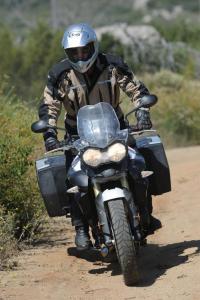
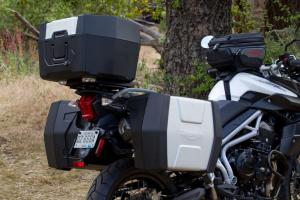
A notable and expensive deficiency spotlighted during our outing wasn’t the bike itself, but rather its accessories. The visually rugged saddlebags ($800) are seemingly built to withstand a Dakar-esque get-off, and I liked their lockable, easy-on, easy-off design that will appeal to commuters. But a component is only as strong as its weakest part, and on these saddlebags it’s the attachment point. Twice I witnessed bags break off of fellow journalist bikes during slow-speed, front-end washouts in the dirt. Off-road warriors will wish for more robust mounts.
 Another nicety is the adjustable seat on both model Tigers.
Increasing or decreasing the seat height on either is a simple process
of removing the seat and repositioning the height bar and returning the
seat to its position on the bike. Why more motorcycle seats do not
provide a seat adjustment this simple is a mystery.
Another nicety is the adjustable seat on both model Tigers.
Increasing or decreasing the seat height on either is a simple process
of removing the seat and repositioning the height bar and returning the
seat to its position on the bike. Why more motorcycle seats do not
provide a seat adjustment this simple is a mystery. What I didn’t appreciate was the unendearing resonance of a spittoon echo emanating from the catalytic converter. This Jiffy Pop pinging sound was present on each Tiger I rode, but under acceleration on certain bikes the sound became a ceramic warble that pierced my earplugs around 7000 rpm. Only certain bikes emitted this sound, while others didn’t, and some journos didn’t even hear the noise, so it seems as if this noise occurrence may be a vagary.
 The XC version of the Tiger is recognizable by its high, beak-like front fender. The XC version of the Tiger is recognizable by its high, beak-like front fender. |
So, to reiterate the emphasis of the two Tigers I’ll venture to say that for the dirtbiker looking for something street-legal, the Tiger XC is the ticket, while the sportbike guy craving some off-road action will probably feel more at home on the standard Tiger. The standard Tiger retails for $1,000 less than the $10,999 XC model. Throw in the optional $800 ABS and you’re still under the MSRP of the XC by $200.
| Comparing Three Adventure Tourers | |||
| Triumph Tiger 800 | Triumph Tiger 800XC | BMW F 800 GS | |
| Engine Type | Liquid-cooled, DOHC, inline, 3-cylinder | Liquid-cooled, DOHC, inline, 3-cylinder | Liquid-cooled, DOHC, parallel twin-cylinder |
| Displacement | 799cc | 799cc | 798cc |
| Bore & Stroke | 74mm x 61.9mm | 74mm x 61.9mm | 82mm x 75.6mm |
| Compression | 11.0:1 | 11.0:1 | 12.0:1 |
| HP (BHP or Rear Wheel) | 94 bhp @ 9300 rpm (claimed) | 94 bhp @ 9300 rpm (claimed) | 85 bhp @ 7500 rpm (claimed) |
| Torque | 58 lb-ft @ 7850 (claimed) | 58 lb-ft @ 7850 (claimed) | 62 lb-ft @ 5750 (claimed) |
| Frame | Tubular Steel Trellis | Tubular Steel Trellis | Tubular Steel Space Frame |
| Wheelbase | 61.2 in | 61.7 in | 62.1 in |
| Rake/Trail | 23.7°/86.2mm | 23.1°/91.1mm | 26.0°/117mm |
| Front Suspension | Showa 43mm upside down fork, 180mm travel | Showa 45mm upside down fork, 220mm travel | 45mm upside down fork, 230mm of travel |
| Rear Suspension | Showa monoshock, preload adjustment, 170 mm travel | Showa monoshock, remote reservoir, preload adjustment, 215 mm travel | Monoshock, preload and rebound adjustment, 215mm travel |
| Front Wheel | 19 in x 2.5 in | 21 in x 2.5 in | 21 in x 2.5 in |
| Rear Wheel | 17 in x 4.25 in | 17 in x 4.25 in | 17 in x 4.25 in |
| Tires | Front: 110/80 ZR19 Rear: 150/70 R17 | Front: 90/90 ZR21 Rear: 150/70 R17 | Front: 90/90 21 Rear: 150/70 17 |
| Front Brakes | Twin two-piston Nissin calipers with 308mm discs | Twin two-piston Nissin calipers with 308mm discs | Twin two-piston calipers with 300mm discs |
| Rear Brakes | Single Nissin caliper with 225mm disc | Single Nissin caliper with 225mm disc | Single piston caliper with 265mm disc |
| Weight | Wet: 462 lbs | Wet: 473 lbs | Wet: 455 lbs |
| Seat Height | 31.9 in/32.7 in | 32.2 in/34.0 in | 33.5 in/34.6 in |
| MSRP | $9,999 | $10,999 | $11,445 |


1 comments :
This story is in Copyright violation. It was stolen in its entirety from Motorcycle.com
Post a Comment