
This will change soon, however, as our annual trek to Laguna Seca for MotoGP includes these two machines, a Yamaha Super Ténéré, Moto Guzzi Stelvio NTX and KTM 990 Adventure. Hundreds of miles of off-road, freeway and twisty pavement will ensue, and we’ll even spend a night camping in the Sierra Mountains. But for now, here’s our take on Triumph’s newest big-bore entry into the Adventure-Touring market.
With minimal off-road riding time, this review largely focuses on the Explorer’s on-road competence, which is apropos as bikes of this nature generally traverse more paved than unpaved miles in their lifetimes. We’ll have a better understanding of its off-road performance whence returning from MotoGP, but let’s get this review underway with an element of equal importance to both types of riding – the engine.

 Probably the Explorer’s best attribute is its 1215cc Triple, Triumph’s newest engine powering both it and the forthcoming Trophy SE.
Producing a claimed 135 horsepower at 9,000 rpm (500 rpm below redline)
and 89 ft-lb of torque at 6,400 rpm, the biggest Tiger in Triumph’s
line-up bests its 800cc stablemate by a claimed 41 hp and 31 more
claimed ft-lb of torque. Like the Tiger 800, the Explorer’s mill
produces gobs of low- and mid-range grunt in a vibration-free power
delivery but with more arm-yanking urgency than the 800.
Probably the Explorer’s best attribute is its 1215cc Triple, Triumph’s newest engine powering both it and the forthcoming Trophy SE.
Producing a claimed 135 horsepower at 9,000 rpm (500 rpm below redline)
and 89 ft-lb of torque at 6,400 rpm, the biggest Tiger in Triumph’s
line-up bests its 800cc stablemate by a claimed 41 hp and 31 more
claimed ft-lb of torque. Like the Tiger 800, the Explorer’s mill
produces gobs of low- and mid-range grunt in a vibration-free power
delivery but with more arm-yanking urgency than the 800. The Tiger Explorer is rife with rider aids including cruise control, anti-lock brakes (ABS) and traction control (TC). The simple pleasure of removing your right hand from the grip to stretch and restore blood flow that cruise control offers is worth the admission price. Selectable in 1-mph increments, a rider can choose the exact speed he wishes to travel, take a breather and enjoy the scenery.
 Our
Tiger Explorer test mule was outfitted with Triumph accessories
including TDLS panniers, alloy bash plate, two-stage heated rider and
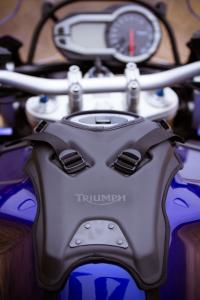
passenger seats, two-stage heated hand grips, tank bag (not shown).
Grand total: $2,150. Our
Tiger Explorer test mule was outfitted with Triumph accessories
including TDLS panniers, alloy bash plate, two-stage heated rider and
passenger seats, two-stage heated hand grips, tank bag (not shown).
Grand total: $2,150. |
Both ABS and TC are switchable, the ABS for on/off and TC with a choice of two positions (#1 more intrusive, #2 less intrusive) and off. Both functions are controlled via left handlebar button operations and visible on the digital instrument cluster. The ABS isn’t as easy as the BMW’s to disengage but it’s not rocket science and with a few practice runs you’ll have the process mastered. Both functions default to “on” whenever the ignition is keyed off.
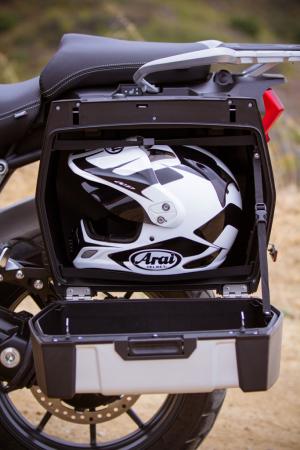
While the Explorer’s saddlebags are susceptible to the same easy breakage, the system does boast Triumph’s Dynamic Luggage System (TDLS). In short, the system is said to help maintain chassis balance by allowing each saddlebag to move through a damped five-degree arc. First introduced on the 2004 Sprint ST, the system has, according to Triumph, been advanced during each subsequent iteration and will be present on the forthcoming 2013 Trophy SE.
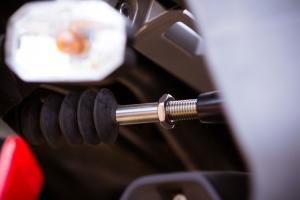 On pavement-only Sprint and Trophy models, the loose attachment of
the bags isn’t as noticeable and may provide some of the performance
benefits Triumph claims, but on the off-road Tiger models the system
allows the luggage to bang around noisily and break off easily which
negates any perceivable advantage the system might provide on the
street.
On pavement-only Sprint and Trophy models, the loose attachment of
the bags isn’t as noticeable and may provide some of the performance
benefits Triumph claims, but on the off-road Tiger models the system
allows the luggage to bang around noisily and break off easily which
negates any perceivable advantage the system might provide on the
street.Time spent aboard the Explorer can be described as comfortable, including rider ergonomics (seat in the high position for those taller than 5’ 10”), windflow from the non-adjustable windscreen, and the optional two-stage heated seat installed on our test bike. For 2012 the Tiger Explorer is available in Phantom Black, Graphite and Sapphire Blue.
 An
expression often associated with GSX-Rs but also befitting the Explorer
is that a rider sits into the Triumph. An adjustable stock seat plus
optional 'low' and 'high' seats allow comfort customization. An
expression often associated with GSX-Rs but also befitting the Explorer
is that a rider sits into the Triumph. An adjustable stock seat plus
optional 'low' and 'high' seats allow comfort customization. |
Is the new Tiger Explorer worth its $15,700, non-accessorized asking price? Possibly. It’s more expensive than Yamaha’s Super Ténéré ($14,500) but less than BMW’s R1200GS ($16,150) so it’s appropriately priced. In a few weeks we’ll have a definite answer as to which bike we prefer. Compared to the 800cc Tigers, the Explorer is more bike, but the lighter, more manageable size of the Tiger 800 and 800XC will get you into and out of more precarious off-road predicaments, leaving you to decide if you require a bike that’s more touring or one that’s more off-road adventurous.
| By the Numbers | |
| Price | $15,699 |
| Engine Type | Inline Triple |
| Displacement | 1215cc |
| Bore x Stroke | 85mm x 71.4mm |
| Horsepower | 135 hp (claimed) |
| Torque | 89 ft-lbs (claimed) |
| Frame | Tubular steel trellis frame |
| Wheelbase | 60.2" |
| Rake/Trail | 23.9-degrees/105.5mm |
| Front Suspension | Kayaba 46mm USD Forks w/190mm travel |
| Rear Suspension | Kayaba monoshock with remote oil reservoir, hydraulically adjustable preload, rebound damping w/194mm travel |
| Front/Rear Wheels | 19-inch/17-inch cast aluminum alloy |
| Tires | 110/80 x 19 Front, 150/70 x 18 Rear |
| Front Brakes | Twin 305mm floating discs, Nissin 4-pistons caliper, switchable ABS |
| Rear Brakes | Single 282mm disc, Nissin 2-piston sliding caliper, switchable ABS |
| Fuel Capacity | 5.3 U.S. gal |
| Wet Weight | 570 pounds |
| Seat Height | Adjustable from 32.9" to 33.7" |


0 comments :
Post a Comment